
Faena Forum, Miami Beach
By Rojina Bohora
Publication date: 15 December 2016, 09:00 GMT
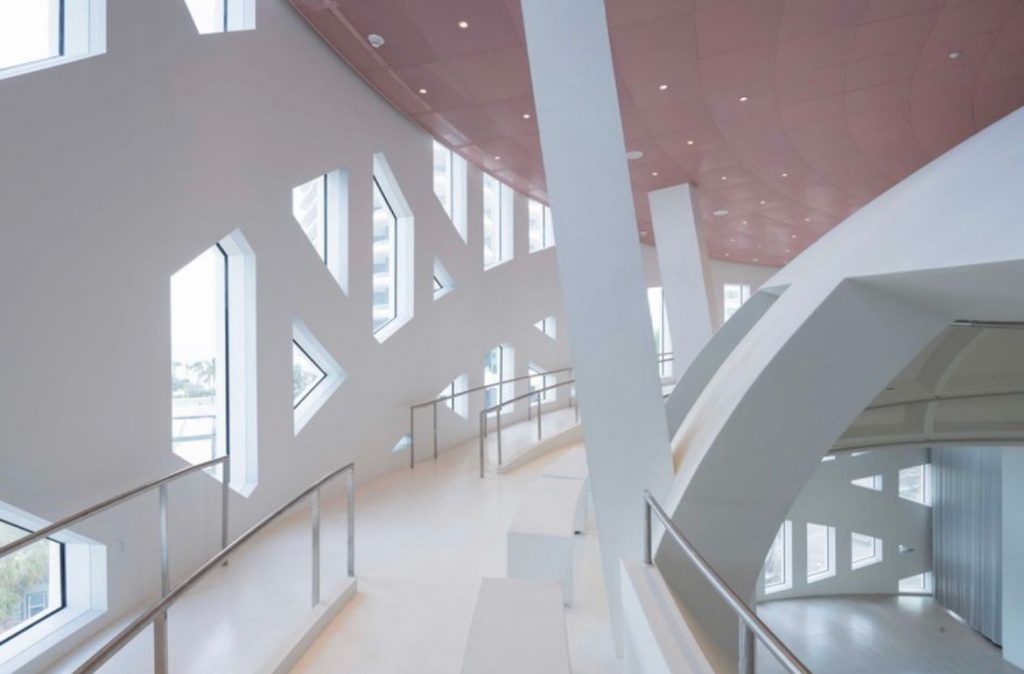
Image credit: Faena Forum, Miami Beach — Architecture by OMA led by Rem Koolhaas. Photographs via Wikimedia Commons, licensed under Creative Commons Attribution–ShareAlike 4.0 (CC BY-SA 4.0). Images used with attribution.
The Civic Cylinder: When Architecture Refused to Choose a Single Use
I.A Building That Refuses to Behave
Miami Beach is accustomed to architecture that performs.
Façades shimmer, interiors seduce, and buildings announce their intentions loudly. Against this backdrop, the Faena Forum arrived in late 2016 as something altogether stranger — a blunt, cylindrical mass of pink-toned concrete, carved with voids and shadows, offering no immediate explanation of itself.
It did not advertise function.
It withheld it.
In doing so, it reintroduced a civic quality rare in contemporary cultural architecture: ambiguity.
II.The Cylinder as Urban Interruption
The forum’s form is disarmingly simple.
A near-perfect cylinder sits just off Collins Avenue, interrupting Miami’s familiar rhythm of horizontality and spectacle. Its geometry resists alignment, orientation, and hierarchy.
There is no obvious front.
No compositional flourish.
The building announces itself not through gesture, but through refusal — a refusal to explain what kind of space it is meant to be.
III. OMA and the Architecture of Programmatic Uncertainty
OMA’s long-standing interest in indeterminate program finds one of its clearest expressions here.
The Faena Forum is neither museum nor theatre, neither gallery nor auditorium. Instead, it is a container for events — lectures, performances, debates, installations — that may change from night to night.
Architecture here does not define use.
It absorbs it.
This indeterminacy is not accidental. It is ideological.
IV.Concrete Without Apology
Concrete dominates the building — heavy, tactile, and unapologetic.
Surfaces are left raw, bearing the marks of construction. Light cuts into mass through carved apertures, creating dramatic chiaroscuro rather than even illumination.
The materiality resists Miami’s polished expectations.
This is concrete as cultural stance, not structural necessity.
V.Voids as Social Devices
Rather than opening the building through transparency, OMA cuts into it.
Voids puncture the cylinder, creating balconies, thresholds, and framed moments of encounter. These cuts choreograph movement vertically and laterally, encouraging gathering rather than circulation.
People are not funnelled.
They are released.
The architecture invites participation without scripting behaviour.
VI.Interior as Continuous Volume
Inside, the forum unfolds as a continuous, spiralling volume.
There are no conventional floors in the usual sense. Platforms and ramps interlock, allowing multiple events to coexist visually and acoustically.
This spatial continuity collapses distinctions between performer and audience, between above and below.
The building stages collective presence.
VII. Civic Space in a Private District
The Faena Forum occupies a curious position within the larger Faena District — a privately developed enclave of hotels, residences, and cultural venues.
Yet the forum resists becoming a branded amenity.
Its architectural seriousness, lack of retail programming, and refusal of spectacle carve out a genuinely civic moment within a curated environment.
It feels public not because it is open, but because it is non-prescriptive.
VIII. Climate, Light, and Weight
In a tropical city dominated by glass, the forum’s mass performs quietly.
Concrete moderates heat. Voids allow air movement. Light enters indirectly, never overwhelming interior space.
The building does not chase comfort through technology alone.
It achieves it through form.
This environmental intelligence is understated, but essential.
IX.Koolhaas and the Legacy of the Forum
The term “forum” is not casual.
Historically, forums were places of assembly, debate, and unpredictability. By reviving this typology — not as plaza, but as interior volume — the project reconnects architecture with civic uncertainty.
It is a space designed for disagreement as much as consensus.
X.Architecture That Requires Patience
The Faena Forum does not reveal itself immediately.
Its power emerges through use — through sound, bodies, movement, and time. Empty, it can appear severe. Occupied, it comes alive.
This patience is deliberate.
The building assumes that meaning will arrive later, through participation.
XI.Miami, Briefly Slowed
In a city oriented toward speed and image, the forum introduces pause.
It asks visitors to look upward, to listen, to navigate space deliberately. It resists passive consumption.
Architecture here is not entertainment.
It is engagement.
XII. Conclusion: When Architecture Creates Room for the Unknown
The Faena Forum does not resolve Miami’s contradictions.
It intensifies them — glamour and gravity, commerce and culture, performance and seriousness — within a single, uncompromising form.
By refusing to define itself too clearly, the building restores something architecture often abandons:
The possibility that space can remain open — intellectually, socially, and politically.
In concrete and shadow, the Faena Forum stands as a reminder that the most civic architecture is not always the most welcoming at first glance —
But the one that leaves room
for the unexpected to occur.
You May also like
By Rojina Bohora
By Rojina Bohora
By Rojina Bohora