
Danjiang Bridge, Taipei
By Rojina Bohora
Publication date: 28 August 2015, 09:00 GMT
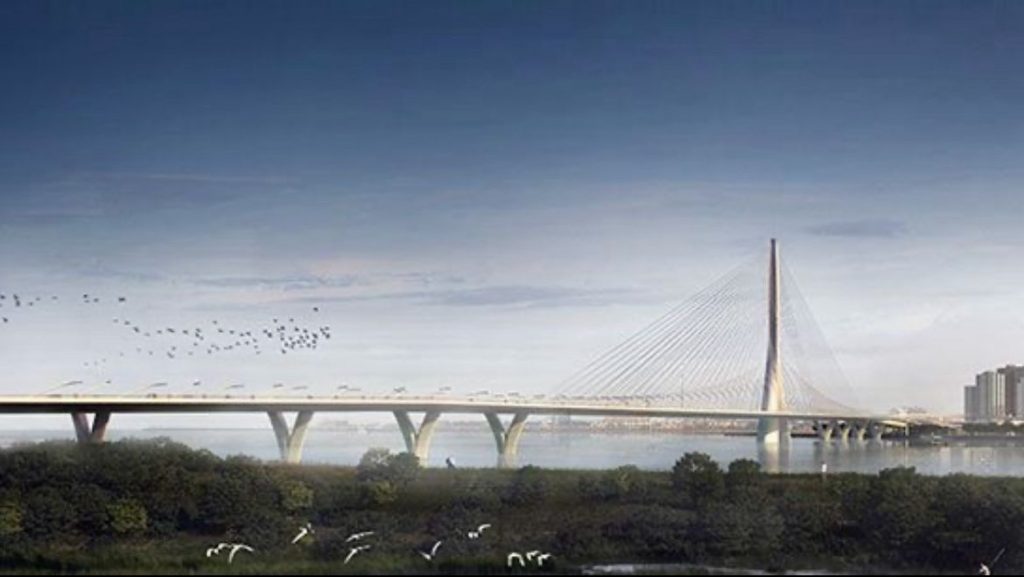
(Image credit: Danjiang Bridge, Taipei — Architecture by Zaha Hadid Architects. Image released by Taipei City Government / ZHA press materials. Used under architect-issued editorial documentation).
One Line Across Water: Engineering, Elegance, and the Refusal of Redundancy
I.The Bridge as Excess — and Its Undoing
Bridges are rarely modest.
They accumulate cables, pylons, trusses, and redundancies, each added in the name of safety, span, or symbolism. Over time, this accumulation becomes aesthetic inevitability: more structure equals more authority.
The Danjiang Bridge begins by asking a different question:
How little can a bridge be, and still hold everything?
Proposed to cross the Tamsui River near its mouth in Taipei, the bridge was unveiled in 2015 with a form that seemed almost implausible — a single, asymmetrical mast supporting the entire span.
One tower.
One plane of cables.
One uninterrupted gesture.
This was not bravado.
It was engineering discipline elevated to architecture.
II.A Singular Mast in a City of Multiplicity
Taipei’s river crossings are dense, infrastructural, and visually busy — layered with highways, rail lines, and urban clutter. Any new bridge here risks contributing to visual noise.
Zaha Hadid Architects responded not by competing, but by subtracting.
The Danjiang Bridge’s defining move is its refusal of duplication. Traditional cable-stayed bridges rely on paired pylons and mirrored cable arrays. Danjiang eliminates one side entirely.
The asymmetry is not stylistic.
It is structural clarity.
III. Engineering Without Ornament
The bridge’s single mast rises in a smooth, tapering curve, anchoring cables that fan outward to support the deck. The geometry is precise, not expressive for its own sake.
Every line performs work.
There are no secondary gestures, no decorative elements attempting to soften the structure. The elegance emerges from load paths made visible.
This is engineering that does not hide behind bulk.
It trusts calculation.
IV.Wind, Water, and the Discipline of Form
At the mouth of the Tamsui River, conditions are unforgiving. Wind loads are extreme. Typhoons are seasonal realities. Salt air accelerates corrosion.
The bridge’s asymmetry is not only visual economy; it reduces aerodynamic drag and turbulence. The single mast minimises obstruction to prevailing winds, while the streamlined deck limits uplift.
Form here is not metaphor.
It is response.
V.Zaha Hadid Architects After Iconography
The Danjiang Bridge occupies a significant moment in the trajectory of Zaha Hadid Architects.
By 2015, the practice was increasingly moving away from the accusation of formal excess toward projects defined by structural logic and infrastructural clarity. Danjiang exemplifies this shift.
There is no surface complexity, no parametric flourish layered onto necessity. The bridge is reduced to its essentials — line, curve, tension.
This is Hadid’s language distilled, not amplified.
VI.The Bridge as Urban Horizon
Seen from the riverbanks, the Danjiang Bridge does not dominate the skyline. It traces it.
The mast rises as a singular vertical marker, while the deck stretches horizontally with minimal visual interruption. The composition frames views rather than blocking them.
The bridge understands its setting: a place where mountains, water, and sky already compete for attention.
Architecture here chooses restraint.
VII. Infrastructure Without Monumentality
Despite its technical ambition — upon completion, it is expected to become the world’s longest single-mast cable-stayed bridge — Danjiang does not behave like a monument.
There is no symmetrical grandeur, no axial drama, no attempt to monumentalise crossing.
Movement across the bridge is intended to feel smooth, continuous, almost effortless. The structure does not announce itself to users. It carries them.
This is infrastructure that values experience over assertion.
VIII. The Ethics of Reduction
Reduction in architecture is often aestheticised. At Danjiang, it is ethical.
Fewer structural elements mean:
- reduced material use
- clearer maintenance logic
- less visual obstruction
- more legible engineering
The bridge argues — quietly — that responsibility lies not in adding safeguards endlessly, but in designing them precisely.
IX.A City That Waits for Its Line
As with many large infrastructural projects, Danjiang’s construction has been prolonged. Political shifts, technical challenges, and economic recalibrations have slowed its materialisation.
Yet the design’s clarity has endured.
Unlike projects whose relevance fades with delay, Danjiang’s proposition remains intact: a bridge that does exactly what it must, and nothing more.
X.Movement as Drawing
There is a graphic quality to the bridge that becomes apparent in elevation: a single arc rising, cables radiating, deck extending.
It reads almost as a line drawing against the sky — a reminder that infrastructure, at its best, approaches the discipline of drawing: clarity, intention, economy.
XI.Beyond the Record-Breaking Impulse
Much has been made of the bridge’s potential record status. This is secondary.
Records expire.
Principles endure.
What distinguishes Danjiang is not how far it reaches, but how cleanly it does so.
XII. Conclusion: The Power of One
The Danjiang Bridge demonstrates that contemporary infrastructure does not require excess to achieve significance.
By committing to a single mast, a single system, and a single uninterrupted idea, the bridge makes a broader architectural claim:
That clarity is not minimalism.
It is confidence.
When completed, the bridge will carry vehicles and people across water.
But even now, as a design, it already carries something rarer:
The conviction that less structure can still hold the world.
You May also like
By Rojina Bohora
By Rojina Bohora
By Rojina Bohora