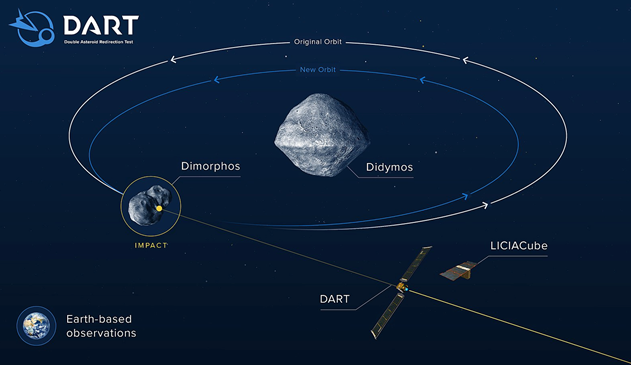
September 26th, 2022, marked a historic milestone in humanity’s quest to safeguard its home planet. NASA’s DART mission successfully altered the orbital trajectory of asteroid Dimorphos, demonstrating for the first time the capability to defend Earth against celestial threats. This groundbreaking achievement signals a new era in planetary defense, where humanity is no longer a passive observer, but an active participant in protecting its planet.
A New Chapter in Cosmic Vigilance
The DART mission proved that humanity possesses the technological prowess to detect, target, reach, and deflect asteroids that pose a threat to our planet. This capability is a game-changer, transforming planetary defense from a theoretical concept to an engineering reality. The methods of deflection, now proven and refined, include:
– Kinetic impactors: crashing spacecraft into asteroids to alter their course
– Gravity tractors: using gravitational forces to subtly shift asteroid trajectories
– Laser ablation: vaporizing asteroid surfaces to create a gentle, yet persistent, thrust
– Nuclear standoff blasts: leveraging nuclear energy to deflect asteroids
– Solar sails / albedo modification: harnessing solar radiation to alter asteroid paths
A Permanent Shift in Human Destiny
The DART mission’s success has etched planetary defense into the fabric of human capability, ensuring that the protection of Earth is no longer a distant dream, but a tangible reality. This achievement serves as a beacon of hope, illuminating the path forward as humanity continues to explore, understand, and safeguard its celestial neighborhood. The cosmos is no longer an uncontrollable force; it is a challenge that humanity is equipped to face head-on.