
The Pantheon And The Room Made By An Opening
By Aletheia Gako
Publication Date: 8 January 2026 — 08:14 GMT
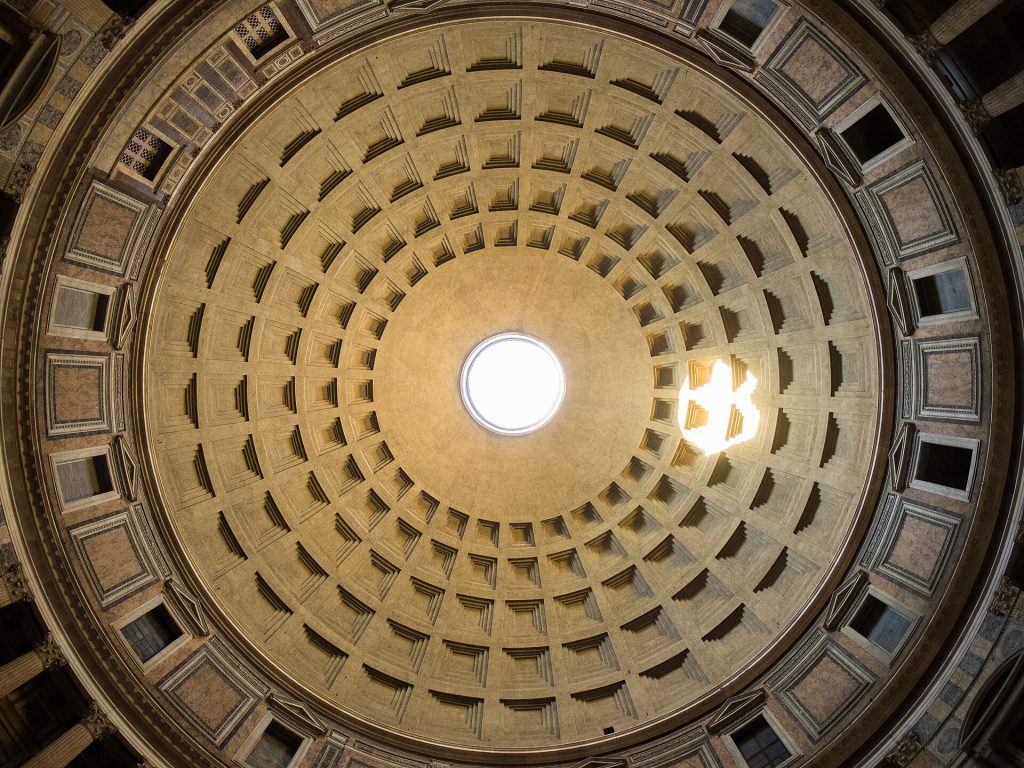
(The oculus and coffered dome of the Pantheon, Rome. Image: Sarahhoa, CC BY-SA 2.0, via Wikimedia Commons.)
Rome’s most extraordinary ceiling makes the changing sky part of its architecture.
The centre of the Pantheon is an absence. Above the marble floor, an opening almost nine metres across admits sunlight, weather and the knowledge that even this immense room has not separated itself entirely from the world. The eye travels upwards expecting a final surface. Instead, it finds the sky.
The surviving Roman building dates from the second century AD. Its internal height and diameter are both a little over 43 metres, allowing an imagined sphere to fit within the rotunda. That relationship is felt before it is understood: the space seems gathered around its visitor, immense yet unusually legible. Geometry provides orientation rather than demanding calculation.
A Room Held By Geometry
Holding the dome above that room required more than a beautiful outline. Its concrete shell becomes thinner towards the crown, while the coffers remove material and articulate the surface. Substantial walls and supporting masonry carry the forces downwards. The apparent ease of the interior rests on a carefully organised distribution of mass. A visitor experiences continuity where the builder had to solve weight.
Light makes that continuity restless. The bright patch admitted by the oculus travels across the curved interior as the sun moves. The room offers a stable frame for a changing event; no electrical installation can reproduce exactly the relation between that beam, a cloud passing overhead and the time of year. Architecture becomes an instrument through which ordinary celestial motion acquires a visible scale.
Rain also enters. Openings in the floor deal with the water, a practical provision often eclipsed by the mythology surrounding the dome. This matters because the building’s encounter with nature was engineered, not merely poetic. A roof that admits weather must be considered together with the surface beneath it.
The Weather Still Enters
The Pantheon became a Christian church in the seventh century and remains a place of worship. Its long life has depended on changed meanings, maintenance and the decisions of successive custodians. Survival should not be mistaken for proof that a building can simply be left alone.
For contemporary architecture, the oculus poses a useful question. What happens when a room’s strongest feature is the relationship it creates rather than the object it displays? Here, a measured opening brings the distant sky close enough to illuminate a person. The achievement is monumental, but the encounter remains intimate.
You May also like
By Aletheia Gako
By Aletheia Gako
By Aletheia Gako