At the Edge of Time: How We Are Discovering the Universe’s First Galaxies
By Rojina Bohora
Published: 3rd April 2026: 08:02 GMT
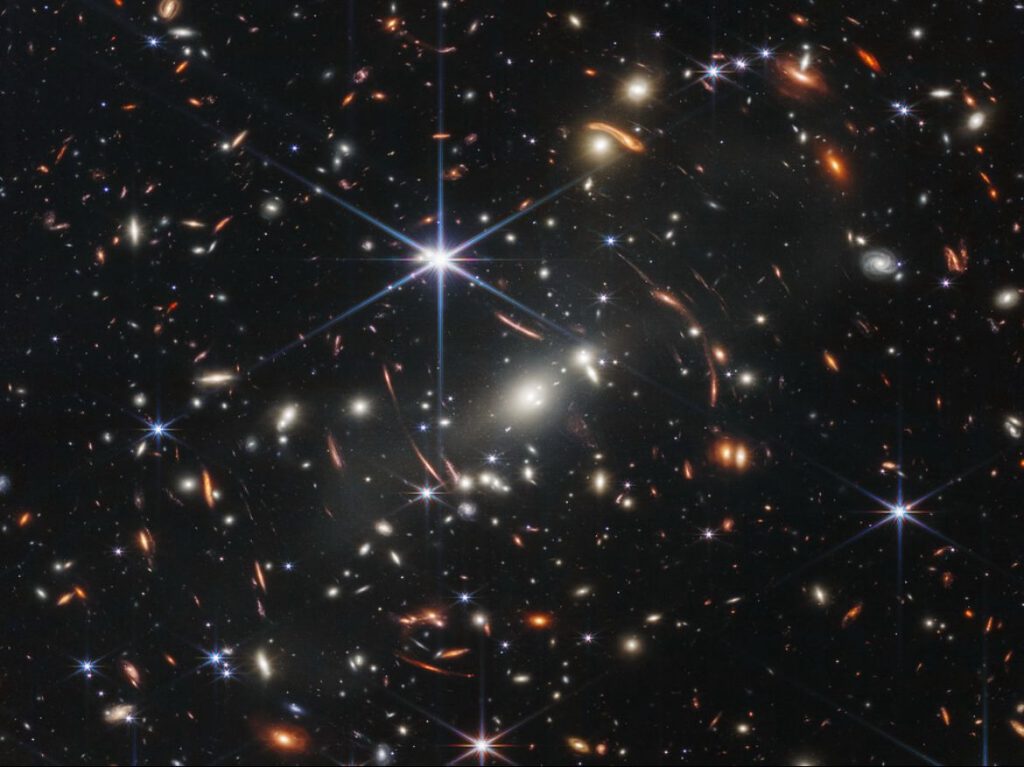
Image Credit: NASA / ESA / CSA / STScI — Public domain (James Webb Space Telescope imagery)
There is a boundary beyond which the universe fades into darkness—not because nothing exists, but because light itself has not had enough time to reach us.
And yet, humanity has begun to see beyond that boundary.
With the advent of the James Webb Space Telescope, we are now observing galaxies that formed just a few hundred million years after the Big Bang. These are not just distant objects; they are relics of cosmic dawn—the moment when the universe first lit up.
The Problem of Seeing the Beginning
Light travels at a finite speed. When we observe distant galaxies, we see them as they were in the past. The farther we look, the further back in time we peer.
But the earliest galaxies present a challenge:
•They are extremely faint
•Their light is stretched (redshifted) into infrared wavelengths
•They are obscured by intervening cosmic material
Earlier telescopes, including the Hubble Space Telescope, could glimpse early galaxies—but not the very first ones.
To see the beginning, we needed a new kind of eye.
Why Infrared Is the Key to Time Travel
As the universe expands, light from distant objects is stretched—a phenomenon known as cosmological redshift.
The earliest galaxies emit light primarily in ultraviolet and visible wavelengths. But by the time that light reaches us, it has shifted into the infrared.
This is why the James Webb Space Telescope was designed as an infrared observatory.
It does not simply see farther—it sees earlier.
What We Are Finding
The discoveries are already rewriting textbooks.
Astronomers expected early galaxies to be:
•Small
•Dim
•Gradually forming over time
Instead, Webb has revealed:
•Massive, structured galaxies far earlier than predicted
•Rapid star formation within a few hundred million years
•Evidence that galaxy formation may have been more efficient than models suggested
These findings challenge our assumptions about how quickly complexity can arise in the universe.
The First Stars: Population III
Before galaxies, there were the first stars—known as Population III stars.
These stars were:
•Composed almost entirely of hydrogen and helium
•Likely extremely massive
•Short-lived and violently explosive
They forged the first heavy elements, seeding the universe with the building blocks of planets, life, and everything we know.
We have not yet directly observed these stars—but we are getting closer.
Every distant galaxy Webb captures may carry indirect evidence of their existence.
Reionization: The Universe Wakes Up
After the Big Bang, the universe entered a period known as the cosmic dark ages—a time before stars and galaxies had formed.
Then came reionization.
The first luminous objects emitted intense radiation, ionizing the surrounding hydrogen and making the universe transparent to light.
Understanding this epoch is one of the central goals of modern cosmology.
With Webb, we are now mapping this transition—not as theory, but as observation.
A Shift in Perspective
For centuries, humanity has asked: Where did everything come from?
Now, we are beginning to answer—not with speculation, but with data.
The earliest galaxies are not just scientific objects. They are origins:
•The origin of structure
•The origin of light
•The origin of chemical complexity
To observe them is to witness the universe becoming itself.
Technology That Makes It Possible
The James Webb Space Telescope represents a triumph of engineering:
•A 6.5-meter segmented mirror for unprecedented sensitivity
•A sunshield the size of a tennis court to block heat and light
•Instruments capable of detecting single photons from billions of years ago
Positioned at the second Lagrange point (L2), it operates in deep cold and darkness—conditions necessary to detect the faintest signals in existence.
This is not just a telescope. It is a time machine built with precision and patience.
What Comes Next
The journey has only begun.
Future missions aim to:
•Directly detect Population III stars
•Map the large-scale structure of early galaxies
•Refine measurements of cosmic expansion
•Search for the first signs of habitable environments
Each discovery pushes the boundary of the observable universe—and with it, the boundary of human understanding.
Conclusion: Seeing the First Light
There was a time when the universe had no stars, no galaxies, no light.
Then something changed.
The first structures formed. The first photons escaped. The first galaxies emerged from darkness.
Today, we are seeing that transformation unfold—not in simulation, but in reality.
To look at these distant galaxies is to witness the universe’s earliest memory.
And in that memory, we find not just the past—
—but the beginning of everything.