
Ardoch, Scotland
By Rojina Bohora
Publication date: 26 October 2019, 09:00 GMT
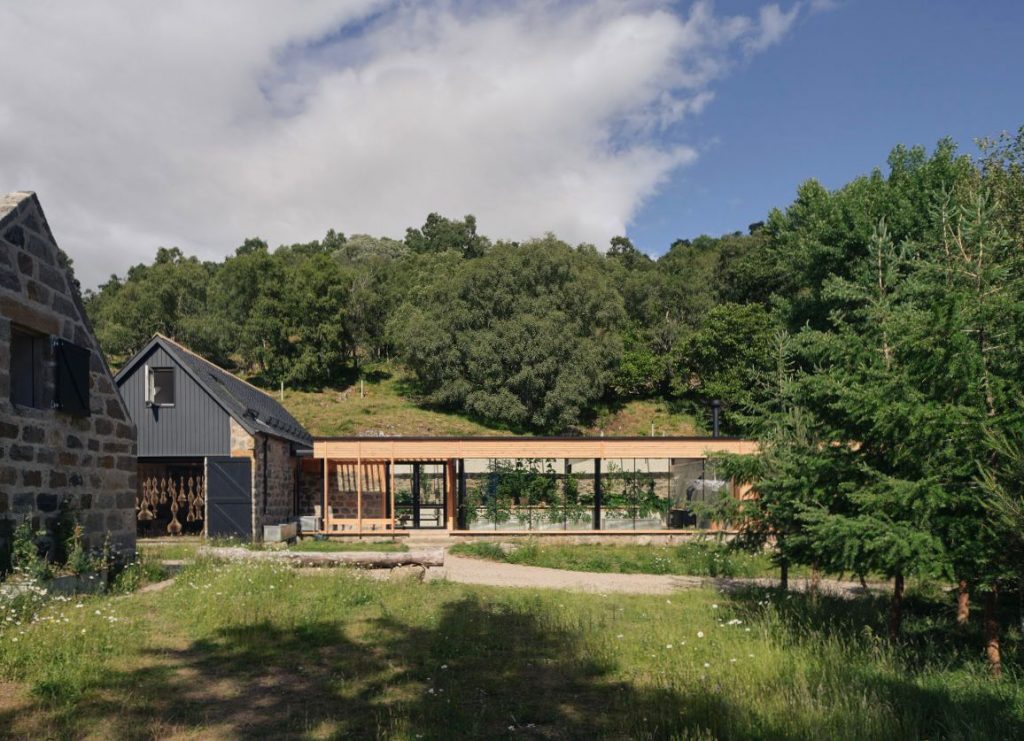
(Image credit: Ardoch, Aberdeenshire — Architecture by Moxon Architects. Photographs released by the architects for editorial use; additional images via Wikimedia Commons under Creative Commons Attribution–ShareAlike 4.0 [CC BY-SA 4.]).
Architecture That Lowers Its Voice: Building Where the Land Already Speaks
I.The Temptation to Compete With Wilderness
Rural architecture often arrives burdened with a misunderstanding: that isolation requires expression.
In landscapes as exposed and elemental as Aberdeenshire, this misunderstanding is magnified. The land already commands attention — through wind, weather, and silence. Buildings that attempt to match this intensity tend to fail.
Ardoch, completed in autumn 2019, recognises this immediately.
It does not compete.
It withdraws carefully.
II.A Building That Appears to Have Always Been There
Set low into the terrain, Ardoch reads less as a new insertion than as a geological adjustment.
Its stone walls echo local material without pastiche. Rooflines follow the land’s contours rather than asserting geometry. From a distance, the building almost disappears.
This is not camouflage.
It is alignment.
The architecture understands that presence can be achieved through continuity rather than contrast.
III. Moxon Architects and the Ethics of Restraint
Moxon Architects’ work has long been defined by a refusal to overstate.
At Ardoch, this restraint is sharpened into principle. Every decision — material, orientation, section — is informed by what the site already offers.
The building does not introduce drama.
It amplifies quiet.
This is architecture as calibration rather than composition.
IV.Stone as Environmental Memory
The use of local stone grounds the project physically and historically.
Stone here is not decorative cladding. It is mass, thickness, and thermal stability. It holds heat, resists wind, and anchors the building to its setting.
The material choice is not nostalgic.
It is practical intelligence inherited.
V.Section Over Elevation
Ardoch’s most important architectural decisions are not visible from the outside.
Section governs experience.
Spaces are partially buried, moderating temperature and light. Roofs shelter deeply. Interiors open selectively toward views, never fully exposing themselves.
The building is designed to be inhabited slowly, not scanned visually.
VI.Light That Enters With Permission
Daylight is controlled, not maximised.
Windows are placed deliberately, often low and horizontal, framing fragments of landscape rather than panoramic scenes. Light enters laterally, grazing surfaces and marking time.
This restraint prevents the landscape from becoming spectacle.
The architecture does not frame views for admiration.
It allows them to be lived with.
VII. Interior as Retreat, Not Escape
Inside, the building is calm and materially honest.
Surfaces are tactile. Spaces are compact without feeling constrained. Fireplaces and sheltered corners reinforce a sense of refuge rather than luxury.
The retreat offered here is not escapism.
It is containment — protection from elements without denial of their presence.
VIII. Weather as Design Partner
Aberdeenshire’s climate is unforgiving, and Ardoch does not attempt to soften it artificially.
Wind is acknowledged through form. Rain is channelled deliberately. Cold is met with mass rather than technology.
The building does not correct the climate.
It responds to it.
IX.Sustainability Without Exhibition
Environmental performance is embedded rather than displayed.
Thermal mass, orientation, and reduced exposure achieve comfort without visible systems. Sustainability is treated as baseline competence, not identity.
There are no gestures asking to be noticed.
X.A Creative Retreat That Respects Silence
Designed to host creative and environmental retreat activity, Ardoch understands that creativity often requires absence rather than stimulation.
The building provides this absence.
It withdraws from noise, from visual overload, from architectural insistence — allowing ideas to surface quietly.
XI.Architecture That Anticipates Weathering
Ardoch is designed to age.
Stone will darken. Metal will dull. Timber will silver. These changes are not defects. They are expected outcomes.
The building’s success lies in how well it will disappear further into the land over time.
XII. Conclusion: When Architecture Knows When to Stop
Ardoch demonstrates a discipline architecture too often forgets:
Knowing when enough has been done.
By building low, choosing restraint, and allowing landscape to remain dominant, the project achieves a rare balance — protective without isolation, present without imposition.
In the open fields of Aberdeenshire, Ardoch does not announce itself.
It listens.
And in listening, it belongs.
You May also like
Fruitmarket Gallery, Edinburgh
By Rojina Bohora
By Rojina Bohora
Rubell Museum, Miami
By Rojina Bohora