
Ismaili Center, Houston, Houston
By Rojina Bohora
Publication date: 13th February 2015; 09:47 GMT
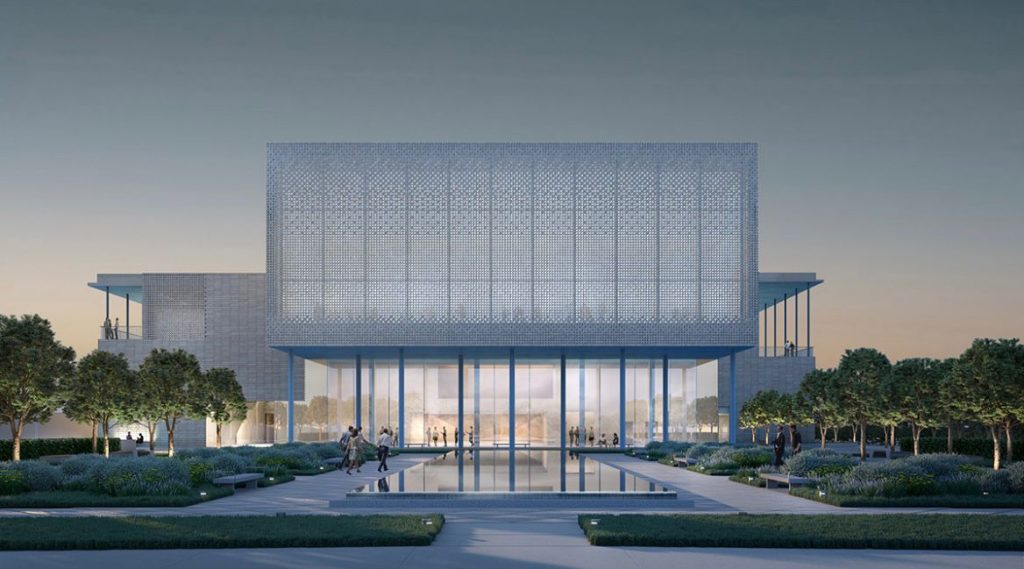
(Image credit: Ismaili Center, Houston — Architecture by Farshid Moussavi Architecture. Image released by the Aga Khan Development Network / project press materials. Used under architect-issued editorial documentation.)
Geometry of Welcome: Faith, Light, and the Architecture of Plural Belonging
I.A Building That Begins With Welcome
Religious architecture often begins with declaration.
It announces belief through mass, hierarchy, and symbolism, establishing boundaries between inside and outside, believer and observer. In plural societies, this architectural posture can unintentionally reinforce distance.
The Ismaili Center in Houston begins elsewhere.
From its earliest public unveiling, the project positioned itself not as an enclave of faith, but as a civic invitation — a place where spiritual life, cultural exchange, and public dialogue overlap without dilution.
This is not architecture that demands reverence.
It offers hospitality.
II.The Ismaili Ethos Made Spatial
The Ismaili community’s long-standing emphasis on knowledge, ethics, and pluralism is not translated here through overt iconography. Instead, it is embedded structurally.
The Center is conceived as both a place of worship and a cultural institution — housing prayer halls, educational spaces, gardens, and gathering areas intended for a broad public.
Faith here is not withdrawn from civic life.
It is woven into it.
This duality shapes every architectural decision.
III. Geometry Without Dogma
The building’s most distinctive feature is its delicate geometric envelope — a lattice of interlocking forms that filters light, air, and view.
Islamic geometric tradition is clearly referenced, but never literalised. Patterns are abstracted, scaled, and recomposed using contemporary fabrication techniques. The result is recognisable without being prescriptive.
This is geometry freed from dogma.
It does not instruct belief.
It creates atmosphere.
- Light as Ethical Medium
Light enters the Ismaili Center indirectly — diffused, softened, moderated. It moves across surfaces rather than striking them theatrically.
This restraint is intentional.
In many sacred spaces, light is deployed to overwhelm. Here, it is used to equalise experience, ensuring that no single vantage point is privileged over another.
The architecture resists hierarchy not only socially, but perceptually.
IV.Gardens as Shared Ground
Surrounding the building are carefully composed gardens — not ornamental landscapes, but spaces of pause and encounter.
Gardens in Islamic architecture have historically functioned as metaphors for paradise. In Houston, they serve a more immediate role: creating neutral ground where visitors of all backgrounds can gather without threshold anxiety.
Nature here is not symbolic escape.
It is social mediator.
The garden is where the building’s civic ambition becomes most tangible.
V.Farshid Moussavi After the Icon
Farshid Moussavi’s work has long resisted the singular icon in favour of systemic clarity — architecture as field rather than object.
The Ismaili Center continues this trajectory.
There is no dominant façade, no heroic elevation. The building is experienced through movement, sequence, and proximity. Meaning emerges cumulatively rather than instantaneously.
This is architecture that trusts time.
VII. Structure as Quiet Discipline
Structurally, the building avoids excess.
The geometric envelope performs environmental work, reducing heat gain while maintaining openness. Load-bearing systems are concealed but legible through rhythm and repetition.
Nothing feels gratuitous.
Nothing feels withheld.
The architecture communicates calm through competence.
VIII. Sacred Space Without Exclusion
One of the most radical aspects of the Ismaili Center is how it handles access.
While certain spaces are reserved for worship, the overall complex maintains an ethos of openness. Educational programmes, exhibitions, and public events are integral rather than ancillary.
The building does not blur faith to achieve inclusion.
It strengthens faith by sharing space.
IX.Houston as Context, Not Contrast
Houston’s architectural landscape is eclectic, expansive, and often indifferent to cohesion. The Ismaili Center does not attempt to dominate this context.
Instead, it introduces a different register: inward-looking yet open, precise yet gentle. It offers an alternative urban rhythm — one that privileges reflection over speed.
In doing so, it expands the city’s architectural vocabulary.
X.Material Restraint and Longevity
Materials are selected for durability and tactility rather than visual excess. Surfaces are designed to age quietly, without patina drama or maintenance spectacle.
This acceptance of time aligns with the building’s broader ethos: continuity rather than momentary impact.
Architecture here is not chasing relevance.
It is committing to presence.
XI.Beyond Representation
The Ismaili Center does not seek to represent Islam in totality. It resists the burden of exemplarity.
Instead, it offers a specific expression — rooted in Ismaili values, open to dialogue, confident without defensiveness.
This specificity is its strength.
XII. Conclusion: Belonging as Architectural Practice
The Ismaili Center, Houston demonstrates that sacred architecture need not rely on assertion to command respect.
By privileging light over monumentality, geometry over iconography, and gardens over gates, the building proposes a different relationship between faith and city.
It suggests that belief, when confident, does not retreat from public life.
It welcomes it in.
And in an era marked by division and misunderstanding, that architectural generosity may be its most enduring contribution.
You May also like
By Rojina Bohora
By Rojina Bohora
By Rojina Bohora