
Bosco Verticale, Milan
By Rojina Bohora
Publication date: 9 January 2015, 09:00 GMT
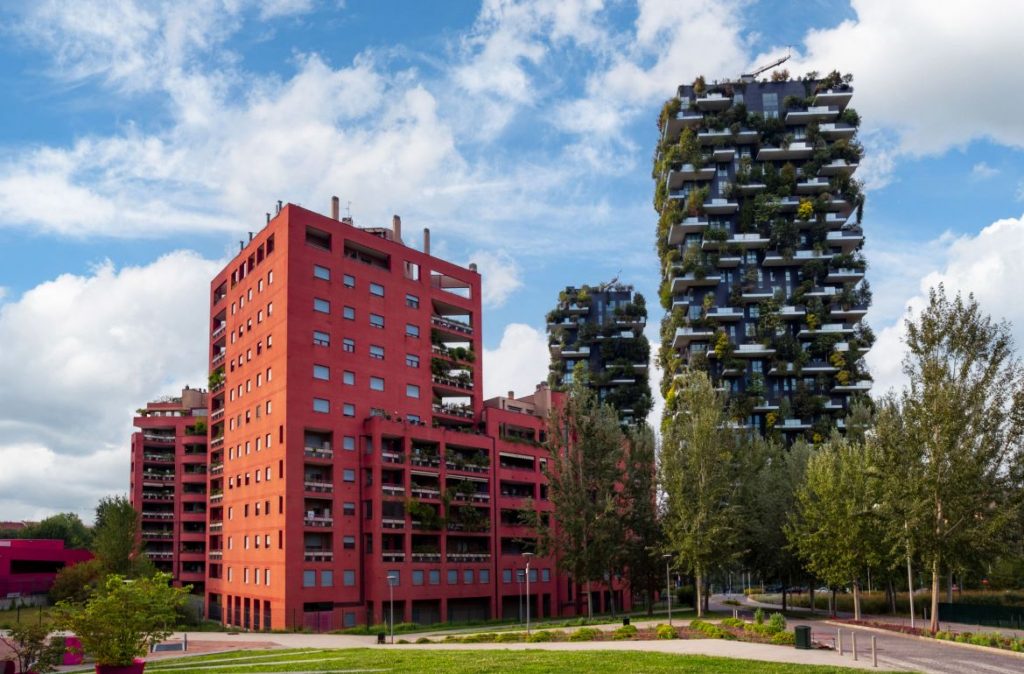
(Image credit: Bosco Verticale, Milan — Architecture by Stefano Boeri Architetti. Photograph via Wikimedia Commons, licensed under Creative Commons Attribution–ShareAlike 4.0 [CC BY-SA 4.0]).
When the City Let the Forest In: Living With Nature at Urban Height
I.The Moment the Balcony Became Landscape
For much of modern architectural history, nature has been treated as something to be framed — a view beyond the window, a park across the street, a compensatory green elsewhere.
Bosco Verticale, inaugurated in Milan in September 2014, inverted this logic entirely.
Here, nature does not sit opposite architecture.
It inhabits it.
The project’s two residential towers do not merely host plants as ornament. They carry an entire ecosystem — trees, shrubs, and groundcover — distributed vertically across balconies and façades, turning elevation into terrain.
This was not a decorative gesture.
It was a conceptual rupture.
II.Against the Metaphor of Green Architecture
Prior to Bosco Verticale, “green” architecture was often metaphorical: buildings shaped like leaves, roofs sprinkled with sedum, sustainability communicated through imagery rather than integration.
Bosco Verticale rejected metaphor.
The vegetation is real, heavy, demanding. Trees are selected species by species, oriented by sun exposure, wind tolerance, and seasonal behaviour. Root systems are engineered. Irrigation is calibrated. Maintenance is continuous.
This is not architecture inspired by nature.
It is architecture obliged to cooperate with it.
III. Structure Under Load — Literally
One of the most radical aspects of Bosco Verticale is not visual, but structural.
Each balcony was designed to support the significant weight of mature trees — soil, water, biomass — imposing loads far greater than conventional residential construction. This required a fundamental rethinking of slab thickness, cantilever behaviour, and long-term performance.
The forest is not an add-on.
It is structural fact.
In accepting this burden, the building commits to its premise without retreat.
IV.Ecology as Urban Infrastructure
The towers collectively host hundreds of trees and thousands of smaller plants — a vertical biomass equivalent to a small forest.
This vegetation:
- absorbs particulate pollution
- moderates microclimate
- reduces urban heat gain
- dampens noise
- supports bird and insect life
These are not symbolic benefits.
They are measurable environmental services.
Bosco Verticale treats ecology not as amenity, but as infrastructure.
V.Living With Growth, Not Image
Unlike static façades, Bosco Verticale changes continuously.
Trees grow. Leaves fall. Seasons register visibly. Balconies look different month to month, year to year. The building never settles into a single image.
This mutability unsettles conventional real-estate logic, which favours predictability and control. Here, residents live with growth rather than against it.
Architecture accepts uncertainty as condition.
VI.Domestic Space Reconsidered
Inside the apartments, the presence of vegetation alters domestic experience fundamentally.
Windows open not onto skyline abstraction, but into branches and leaves. Light is filtered. Privacy is mediated by foliage rather than curtains alone. The boundary between interior and exterior becomes porous.
The city is not excluded.
It is translated through greenery.
Living here means inhabiting an interface rather than an enclosure.
VII. Maintenance as Ethical Commitment
Bosco Verticale has often been criticised on the grounds of maintenance — the cost, the expertise, the labour required to sustain its vegetation.
These critiques are not incorrect.
They are revealing.
The building exposes a truth often avoided: meaningful ecological integration requires ongoing care. There is no one-time solution, no static sustainability.
Bosco Verticale does not promise ease.
It demands stewardship.
VIII. Against Replication as Shortcut
In the years since its completion, countless “vertical forests” have been proposed worldwide. Many misunderstand the lesson.
Bosco Verticale is not a style.
It is a specific ecological response to Milan’s density, climate, and air quality challenges.
Replicating its appearance without replicating its discipline produces imitation without integrity.
The project’s importance lies not in its image, but in its insistence that cities must renegotiate their relationship with nature structurally, not symbolically.
IX.A City That Changed the Conversation
Milan did not become greener overnight because of Bosco Verticale. But the project shifted discourse.
It made visible the possibility that dense urban living need not exclude biodiversity. It reframed balconies — long treated as marginal — as primary ecological actors.
It changed what could be imagined.
X.The Human Scale of the Forest
Despite its ambition, Bosco Verticale remains domestic.
Residents water plants. Birds nest outside bedrooms. Seasons enter daily routine. The forest is not abstract — it is intimate.
This intimacy distinguishes the project from grand landscape gestures that remain distant from everyday life.
Here, ecology is lived, not admired.
XI.Architecture After Separation
Modern architecture has long been defined by separation:
- inside from outside
- building from landscape
- human from non-human
Bosco Verticale challenges this structure at its root.
It proposes coexistence rather than control, integration rather than mitigation.
This is not utopian.
It is pragmatic — and demanding.
XII. Conclusion: A Forest That Refused to Stay Outside
Bosco Verticale does not offer a universal model.
It offers a provocation.
It asks whether cities might accept the complexity of living systems within their densest forms — not as decoration, but as obligation.
In doing so, it reframes sustainability from performance metric to relationship.
The towers stand today not as green icons, but as living arguments — that urban life and natural life need not be opponents.
They can, with care and commitment,
grow together.
You May also like
By Rojina Bohora
By Rojina Bohora
By Rojina Bohora