
Chengdu Greenland Tower, Chengdu
By Rojina Bohora
Publication date: 29 September 2015, 09:00 GMT
(Image credit: National Memorial for Peace and Justice, Montgomery — Architecture by MASS Design Group. Photograph via Wikimedia Commons, licensed under Creative Commons Attribution–ShareAlike 4.0 [CC BY-SA 4.0]).
The Mountain That Waits: Altitude, Aspiration, and the Ethics of the Unfinished
I.When a Tower Is Announced, Not Yet Built
Some buildings exist long before they are constructed.
They circulate through images, exhibitions, skyline renderings, and speculative futures. They influence discourse, ambition, and urban psychology — even while remaining materially absent.
The Chengdu Greenland Tower is one such building.
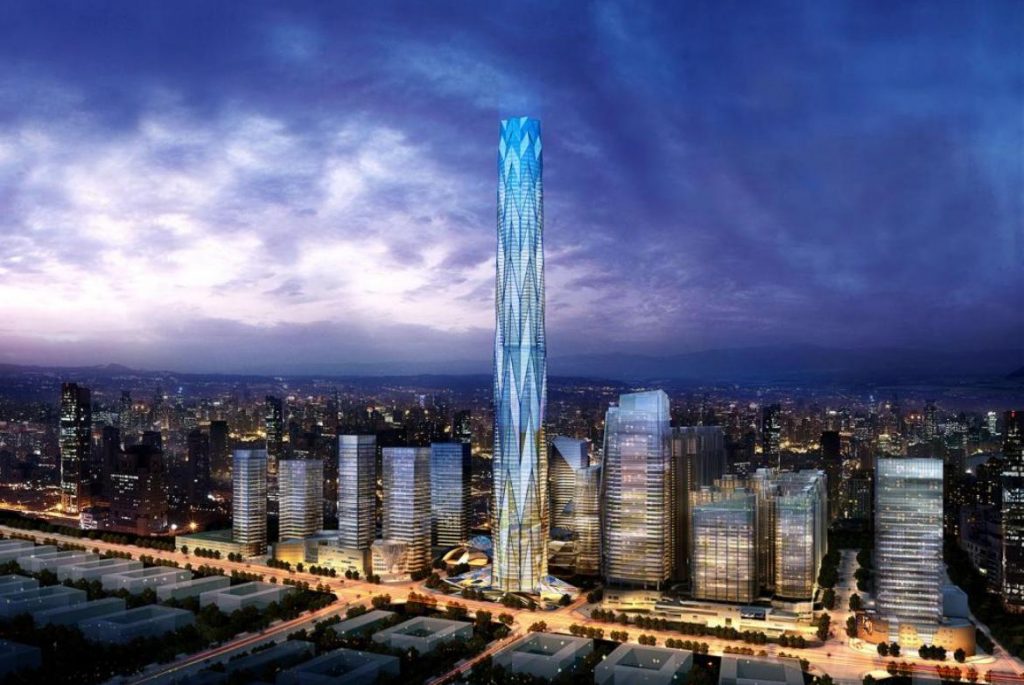
Unveiled publicly in 2014 as a near-500-metre supertall destined to become one of Western China’s highest structures, the tower arrived first as an idea of altitude — a proposition about what Chengdu might become, rather than what it already was.
That it remains uncompleted does not diminish its significance.
It sharpens it.
II.Chengdu and the Question of Vertical Identity
Chengdu is not Shanghai.
It is not Shenzhen.
It is not defined by coastlines or finance-first skylines.
Its identity is shaped by basin geography, agricultural richness, and proximity to the mountains of Sichuan. It is a city historically oriented outward toward landscape rather than upward toward abstraction.
To propose a supertall here was therefore not inevitable. It was ideological.
The Greenland Tower was conceived not as generic height, but as topographic translation — a skyscraper that would echo the surrounding snow-capped peaks through tapering geometry and crystalline articulation.
This is not metaphor applied after the fact.
It is form as geographic argument.
III. The Aerodynamics of Restraint
Designed by Adrian Smith + Gordon Gill Architecture, the tower’s form narrows as it rises, reducing wind load and structural demand. This aerodynamic shaping is not merely technical; it governs the building’s visual presence.
Rather than blunt verticality, the tower reads as ascendant but disciplined — height achieved through calibration rather than force.
In the lineage of Smith’s work, this marks a continued evolution away from the heroic extrusions of early supertalls toward environmentally moderated altitude.
IV.Superheight Without Glass Bravado
Unlike many contemporaneous towers that rely on pure glass spectacle, the Chengdu Greenland Tower was designed with a faceted, crystalline façade — articulated to manage solar exposure and reduce glare.
The surface is intended to catch light unevenly, breaking down scale rather than amplifying it. The building would shimmer rather than glare, reflect rather than dominate.
This matters in a city where haze, climate, and atmospheric density shape daily experience.
The tower does not seek visual supremacy.
It seeks environmental accommodation.
V.Program as Vertical Continuum
The tower’s mixed-use program — offices, hotel, observation spaces — is arranged not as stacked isolation, but as a vertical continuum of public and semi-public experience.
Observation decks were conceived not merely as tourist platforms, but as civic vantage points — places where the city could be read against its basin geography and distant mountains.
Height here is not private privilege.
It is shared perspective.
VI.The Ethics of the Unfinished
To speak of an uncompleted tower is to confront an uncomfortable architectural truth: not all ambition resolves into matter.
Economic cycles shift. Developers falter. Political priorities realign. In such contexts, the unfinished building becomes emblematic — not of failure alone, but of the limits of projection.
The Chengdu Greenland Tower exists today as a paused future.
And yet, its influence persists.
It shaped local debate about skyline height, environmental performance, and Chengdu’s place within China’s urban hierarchy. It expanded the city’s architectural imagination even in absence.
VII. Against the Myth of Inevitable Height
The early 2010s produced a global assumption that every major city would eventually claim a supertall — as marker of arrival, competitiveness, relevance.
The pause of the Greenland Tower complicates this narrative.
It suggests that height is not destiny.
It must be justified continuously, not announced once.
This is not a failure of architecture.
It is a recalibration of responsibility.
VIII. Architecture as Long Conversation
Too often, architectural criticism focuses only on completed objects.
But cities are shaped equally by what is proposed, debated, delayed, and reconsidered. The Chengdu Greenland Tower belongs to this longer conversation — one about ambition in a city still negotiating its vertical future.
Its design remains disciplined, coherent, and environmentally literate — qualities that continue to inform discourse even without physical presence.
IX.A Mountain That Does Not Rush
There is something almost appropriate about the tower’s delay.
Mountains do not hurry.
They define horizon patiently.
In seeking to echo Sichuan’s peaks, the tower inadvertently adopted their temporality — asserting presence without insisting on immediacy.
X.Conclusion The Power of the Conditional
The Chengdu Greenland Tower reminds us that architecture is not only about what is built.
It is also about:
- what is imagined
- what is postponed
- what is reconsidered
As an uncompleted project, it resists easy celebration. But as an architectural proposition, it remains rigorous, culturally situated, and environmentally thoughtful.
It stands — for now — as a conditional form:
A tower that asks not how high can we build,
but why, when, and for whom.
And in asking those questions, it contributes something rare:
Altitude with self-awareness.
You May also like
By Rojina Bohora
By Rojina Bohora
By Rojina Bohora