
Elizabeth Line – Bond Street Station, London
By Rojina Bohora
Publication date: 7 June 2022, 09:00 GMT
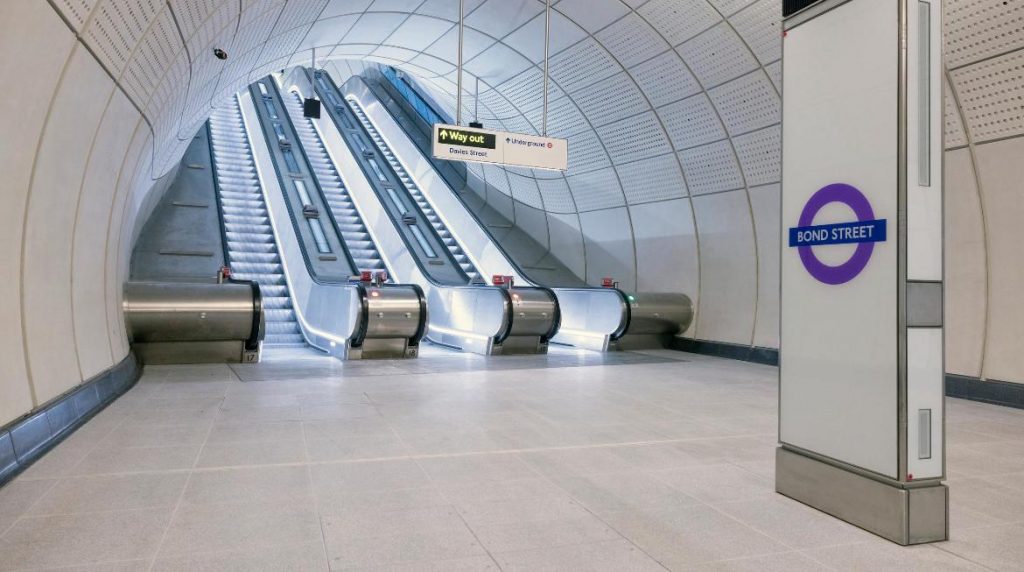
(Image credit: Elizabeth Line – Bond Street Station, London — Architecture by John McAslan + Partners. Photograph via Wikimedia Commons, licensed under Creative Commons Attribution–ShareAlike 4.0 [CC BY-SA 4.0]).
Depth Without Darkness: How Infrastructure Learned the Language of Calm
I.The Rarity of Quiet Achievement
Large infrastructure projects are rarely subtle.
They announce scale, cost, and complexity through visual drama or technological display, often compensating for disruption with spectacle. The Elizabeth Line — Europe’s largest transport project of the early 21st century — could easily have followed this path.
Bond Street Station did not.
Opened to the public in May 2022 after years of excavation beneath one of London’s most historic districts, the station offers something almost countercultural: calm.
Not minimalism.
Not neutrality.
But calm as a spatial ethic.
II,Building Beneath a City That Never Stops
Bond Street sits beneath layers of London history — Georgian streets, Victorian commerce, modern retail, and the constant churn of the West End. Excavating here was not merely an engineering challenge; it was a negotiation with time.
The station’s architecture reflects this sensitivity.
Rather than competing with the city above, the design retreats into disciplined clarity. Forms are large but legible. Surfaces are restrained. Circulation is intuitive.
The station does not dramatise depth.
It reassures within it.
III. Cathedral Scale Without Monumentality
One of the station’s most striking qualities is its scale.
Platforms and concourses are expansive, almost monumental in volume. Yet they avoid the authoritarian tone that often accompanies such dimensions. This is achieved through proportion rather than ornament.
Curved walls guide movement gently. Ceiling heights are generous but not overwhelming. The spatial sequence unfolds gradually, allowing the body to adjust rather than be confronted.
Grandeur here is not imposed.
It is earned through coherence.
IV.Stone, Steel, and the Refusal of Gloss
Material choices at Bond Street are notably restrained.
Natural stone anchors the station in a sense of permanence, echoing the geology beneath London itself. Brushed steel provides precision without reflectivity. Surfaces absorb light rather than scatter it theatrically.
There is no high-gloss futurism here.
No attempt to aestheticise technology.
The station’s materials age well by design. They anticipate decades of use, abrasion, and touch.
This is infrastructure that accepts longevity as responsibility.
V.Light as Orientation, Not Effect
Lighting is where many underground stations falter — either too dim to reassure or too bright to be humane.
Bond Street strikes a careful balance.
Light is diffused, even, and directional. It clarifies circulation without shouting instruction. Changes in brightness subtly signal transitions between concourse, escalator, and platform.
The station teaches orientation through atmosphere rather than signage overload.
Light here is not spectacle.
It is guidance.
VI.Movement Without Compression
Crowd management is often achieved through control: barriers, bottlenecks, signage that disciplines behaviour.
Bond Street adopts a different approach.
By providing generous widths, clear sightlines, and intuitive paths, the architecture allows movement to organise itself. People flow rather than funnel. Waiting feels temporary rather than punitive.
This matters in a city where public transport is daily ritual rather than occasional event.
The station respects the intelligence of its users.
VII. Infrastructure as Civic Interior
One of the Elizabeth Line’s most significant contributions is its redefinition of what underground space can be.
Bond Street Station does not feel like a technical cavity beneath the city. It feels like a civic interior — a shared room beneath London where strangers coexist without friction.
This is not accidental. It reflects a belief that public infrastructure should dignify daily life rather than merely process it.
VIII. Against the Aesthetics of Stress
Many transport environments communicate urgency through design: sharp angles, loud graphics, aggressive lighting.
Bond Street does the opposite.
Its architecture lowers the register of experience. The station does not amplify the city’s pace; it tempers it. In doing so, it acknowledges the psychological dimension of infrastructure.
Calm becomes a form of care.
IX.The Invisible Labour of Precision
What makes Bond Street Station successful is precisely what makes it difficult to photograph as spectacle.
The joints are precise.
The alignments exact.
The tolerances unforgiving.
This precision disappears into experience — the hallmark of architectural maturity.
The building does not demand admiration.
It rewards familiarity.
X.London’s Infrastructure Grows Up
The Elizabeth Line represents a generational shift in how London builds.
Bond Street Station, in particular, signals a move away from ad-hoc accumulation toward integrated design thinking — where engineering, architecture, and public experience are aligned from the outset.
Infrastructure here is not apology for disruption.
It is confidence in competence.
XI.Timelessness Without Nostalgia
Despite its contemporary execution, Bond Street Station avoids futurist clichés that date quickly.
There are no gimmicks.
No stylistic timestamps.
The station feels contemporary because it is precise, not because it is fashionable. It understands that infrastructure should age quietly, without embarrassment.
XII. Conclusion: Depth That Holds, Not Presses
Bond Street Station demonstrates that depth need not feel oppressive, and scale need not feel authoritarian.
By choosing calm over drama, clarity over assertion, and durability over display, the architecture elevates a daily necessity into a civic experience of unusual grace.
This is infrastructure that does not demand attention —
but earns trust.
And in a city built on layers, trust may be the most valuable structure of all.
You May also like
By Rojina Bohora
By Rojina Bohora
By Rojina Bohora