
South Station Redevelopment, Boston
By Rojina Bohora
Publication date: 3 August 2016, 09:00 GMT
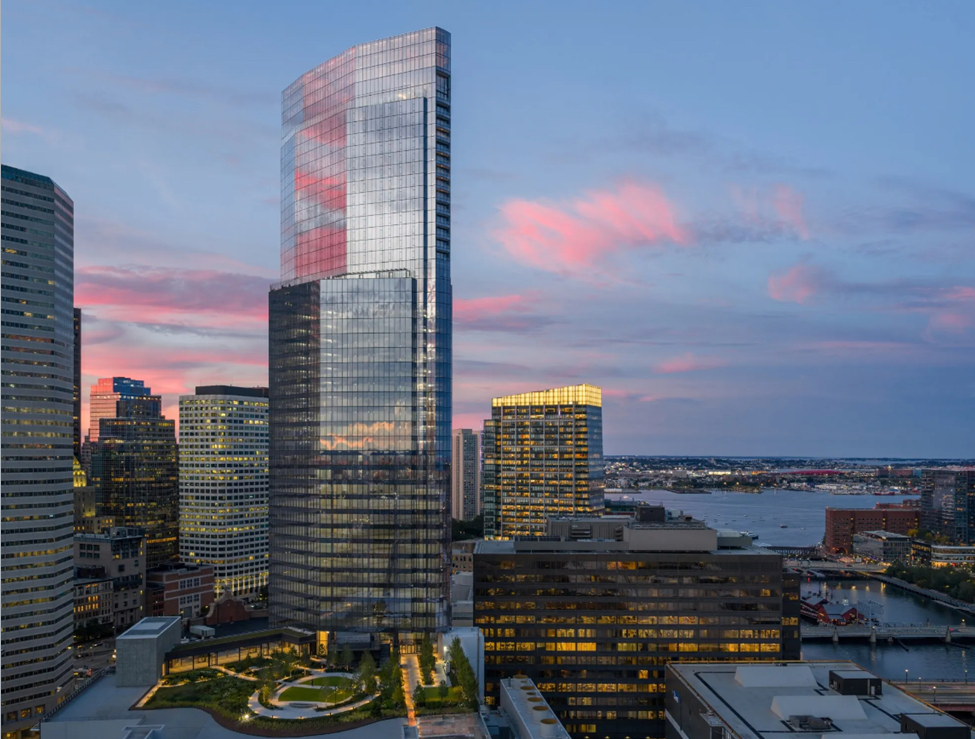
(Image credit: South Station Redevelopment, Boston — Architecture by Pelli Clarke & Partners. Photograph via Wikimedia Commons, licensed under Creative Commons Attribution 4.0 [CC BY 4.0]).
Building Above Continuity: How a City Learned to Layer Rather Than Replace
I.The Risk of Building Above History
Few urban gestures are as fraught as building over a functioning civic landmark.
South Station is not just a building. It is Boston’s principal transportation hinge — a place of daily ritual, economic movement, and collective memory. Any attempt to densify this site risks collapsing infrastructure into spectacle or subordinating public utility to private ambition.
The South Station Redevelopment proposes something more disciplined: vertical continuity rather than replacement.
Announced in mid-2016, the project sets out to layer new life above an existing one — not as domination, but as structural coexistence.
II.Infrastructure as Civic Inheritance
Completed in 1899, South Station has long functioned as an infrastructural constant in a changing city. Trains arrive, commuters pass through, commerce hums — largely indifferent to architectural fashion.
This endurance creates a particular ethical challenge.
How does one add density without diminishing trust?
How does one increase value without extracting it from public life?
Pelli Clarke & Partners’ response is notable for its restraint. The tower does not intrude into the station’s historic concourse. It rises above it — structurally independent yet functionally interdependent.
The old station continues uninterrupted below.
The city continues to move.
III. Verticality Without Erasure
Unlike many transit-adjacent developments, the South Station Tower does not seek to erase its base through visual dominance.
Its form is slender, calibrated, and legible from a distance without overwhelming the station’s historic identity. Glass and metal are employed not to dazzle, but to recede into skyline continuity.
This is verticality without bravado.
The building understands that its legitimacy depends not on visibility alone, but on non-interference.
IV.Urban Layering as Architectural Skill
The project’s most significant achievement lies in its sectional intelligence.
Transportation infrastructure, retail, public concourse, commercial offices, and residential or hotel functions are stacked — not compressed — each retaining spatial clarity and operational autonomy.
This layering is not accidental. It reflects an understanding that cities do not function horizontally anymore, but they cannot afford vertical confusion either.
South Station Redevelopment treats section as civic instrument.
V.Sustainability Through Density, Not Displacement
Transit-oriented development often claims sustainability by proximity alone. South Station Redevelopment goes further.
By concentrating program directly above a major transit hub, the project reduces reliance on private vehicles, shortens daily commutes, and intensifies land use without expanding the city’s footprint.
Importantly, it does so without displacing the station’s existing users or function.
Sustainability here is not technological theatre.
It is urban logic.
VI.The Station Below Still Belongs to the City
One of the most frequent failures of mixed-use megaprojects is the quiet privatisation of public space. Concourse areas become curated retail environments; circulation becomes consumption.
South Station resists this drift.
The historic concourse remains publicly legible and accessible. Circulation patterns are preserved. The daily commuter is not made subordinate to the tower above.
This balance is difficult — and rare.
VII. Glass as Neutral Medium, Not Statement
The tower’s glass façade has been criticised by some as conservative. This criticism misunderstands its role.
In a context as charged as South Station, architectural neutrality is not absence of ambition. It is strategic deference.
The tower does not seek to redefine Boston’s skyline iconographically. It seeks to integrate into it responsibly.
Architecture here does not perform innovation.
It performs compatibility.
VIII. The Economics of Civic Densification
Redeveloping a site like South Station is economically complex. Public agencies, private developers, and civic stakeholders operate on different timelines and priorities.
The project’s significance lies not in resolving these tensions, but in spatialising them honestly.
Public infrastructure remains public.
Private development funds expansion rather than extraction.
Value is added vertically without hollowing the base.
This is densification without dispossession.
IX.Against the Myth of the Blank Slate
Urban redevelopment often relies on the fiction of the blank slate — demolish, replace, reset.
South Station Redevelopment rejects this mythology entirely.
The building acknowledges that cities are accumulative, not erasable. Growth must occur through existing systems, not by pretending they are obsolete.
This is architecture that understands cities as palimpsests, not products.
X.Boston’s Conservative Modernity
Boston is a city that distrusts architectural bravado — and for good reason. Its identity is shaped by continuity rather than rupture.
The South Station Tower aligns with this temperament. It is modern without provocation, contemporary without rupture.
Its ambition is civic rather than visual.
XI.Infrastructure That Learns to Age
One of the project’s understated strengths is its commitment to durability.
Materials, systems, and detailing prioritise longevity over novelty. The tower is not designed to age as a relic of a moment, but as a working component of the city.
This temporal humility is architectural maturity.
XII. Conclusion: Building With the City, Not Over It
The South Station Redevelopment does not redefine Boston.
It respects it.
By building above a living civic institution without overwhelming it, the project demonstrates a model of urban growth that values continuity over conquest.
It suggests that the future of dense cities lies not in replacement, but in careful addition — in learning how to build with what already works.
In an era of architectural impatience, this patience is its quiet achievement.
You May also like
By Rojina Bohora
By Rojina Bohora
National Memorial for Peace and Justice, Montgomery, Alabama
By Rojina Bohora