
James Simon Gallery & Neues Museum, Berlin
By Rojina Bohora
Publication date: 26 July 2019, 09:00 GMT
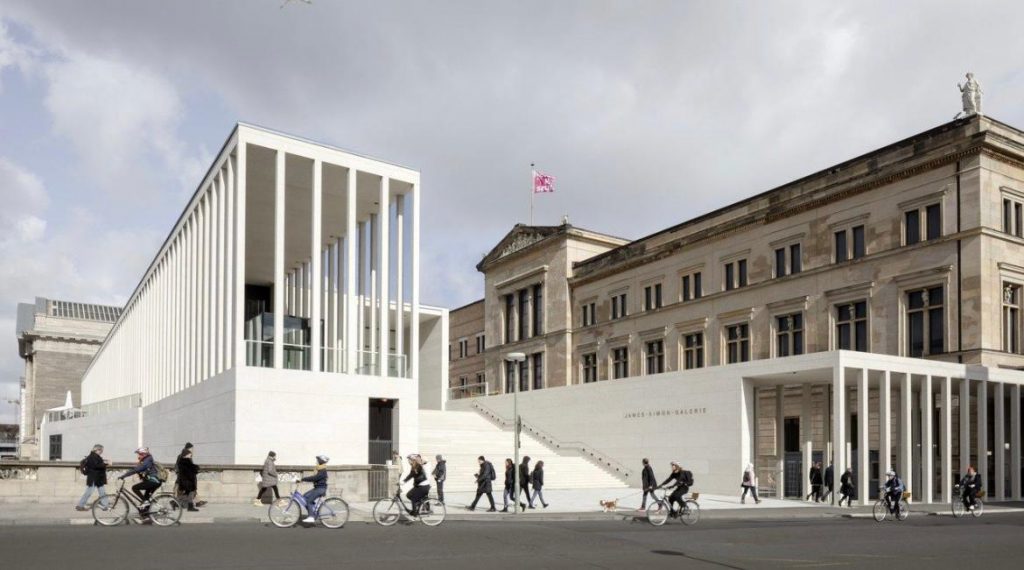
(Image credit: James Simon Gallery & Neues Museum, Berlin — Architecture by David Chipperfield Architects. Photograph via Wikimedia Commons, licensed under Creative Commons Attribution–ShareAlike 4.0 [CC BY-SA 4.0]).
The Architecture of Restraint: How Modernity Learned to Speak Softly on Museum Island
I.Entering Without Interrupting
Museum Island is not a place that welcomes interruption.
Its neoclassical temples — the Altes Museum, the Pergamon, the Bode — were conceived as monuments to permanence, authority, and cultural inheritance. Any contemporary addition risks either mimicry or provocation. Most choose one. David Chipperfield chose neither.
The James Simon Gallery, opened in July 2019, does not announce itself as a new landmark. It does something far more difficult: it makes arrival possible without altering the tone of the sentence already being spoken.
This is architecture that understands when to lower its voice.
II.The Problem of the Threshold
For decades, Museum Island suffered from an architectural paradox. It possessed some of the most significant collections in Europe, yet lacked a coherent point of entry. Visitors arrived piecemeal, disoriented by competing facades and institutional boundaries.
The James Simon Gallery resolves this not through dominance, but through mediation.
It functions as a shared threshold — ticketing, orientation, circulation — binding disparate museums into a legible whole. Importantly, it does so without becoming the focus of attention itself.
Threshold architecture rarely earns praise.
Here, it earns trust.
III. Marble Without Authority
The gallery’s exterior is defined by slender marble colonnades — an unmistakable reference to classical language. But where neoclassicism often relies on mass and hierarchy, Chipperfield pares the form down to rhythm and proportion.
Columns are thin. Spacing is deliberate. Surfaces are cool, matte, unassertive.
This is not quotation.
It is translation.
The building speaks classical syntax without repeating classical rhetoric. It acknowledges lineage while refusing nostalgia.
IV.Silence as Architectural Skill
What distinguishes the James Simon Gallery is not what it adds, but what it refrains from adding.
There is no ornamental flourish, no symbolic gesture demanding interpretation. The architecture operates through alignment, repetition, and calm material consistency.
In a cultural context where new museums often shout their relevance, this silence is radical.
Silence here is not emptiness.
It is confidence without vanity.
V.Interior Movement as Choreography
Inside, the building unfolds as a sequence of controlled movements.
Broad stairs rise slowly, drawing visitors upward without spectacle. Light enters obliquely, filtered rather than dramatized. Views frame fragments of the surrounding museums, reminding visitors where they are without overwhelming them.
Circulation is not efficient in the reductive sense. It is deliberate.
The architecture insists that arrival should take time — that cultural engagement begins before the gallery door.
VI.The Neues Museum: Repair as Intellectual Position
The James Simon Gallery cannot be understood without the Neues Museum.
Chipperfield’s earlier restoration of the war-damaged museum, completed in 2009, established an approach that now feels foundational: preservation without falsification.
Rather than reconstructing the museum to an imagined original state, Chipperfield stabilised ruin, integrated new materials visibly, and allowed absence to remain legible.
This refusal to lie architecturally was controversial at the time. It is now widely regarded as exemplary.
VII. Old and New Without Hierarchy
Together, the James Simon Gallery and the Neues Museum form an ensemble that resists hierarchy.
Neither dominates. Neither recedes entirely. The new building does not frame the old as relic; the old does not diminish the new as intruder.
They coexist through mutual discipline.
This relationship is rare. Too often, contemporary architecture either genuflects theatrically or asserts relevance aggressively. Here, relevance emerges through continuity of care.
VIII. Material Honesty and Time
Material choices throughout both projects emphasise longevity over impression.
Stone, concrete, and plaster are used with restraint. Joints are legible. Repairs are visible. Nothing is disguised as seamless.
This honesty extends temporally. The buildings do not attempt to suspend time. They accept aging as part of their future identity.
Architecture here is not frozen.
It is durable
IX.The Ethics of Cultural Stewardship
At a moment when museums are increasingly scrutinised for the origins of their collections and the narratives they project, architecture plays a subtle but crucial role.
The James Simon Gallery does not attempt to reframe history. It prepares visitors to encounter it critically.
By slowing movement, clarifying orientation, and resisting spectacle, the building creates space for reflection rather than consumption.
It treats culture not as event, but as responsibility.
XII.Berlin, Memory, and Restraint
Berlin is a city where architecture is burdened with memory. Every addition participates in a dense moral landscape shaped by destruction, division, and reconstruction.
Chipperfield’s work on Museum Island aligns with this context precisely because it refuses resolution.
The buildings do not offer redemption narratives. They offer careful continuity — a way of building that acknowledges fracture without dramatizing it
XI.Against Architectural Narcissism
The James Simon Gallery is an argument against architectural narcissism.
It does not seek authorship recognition through form. It does not compete for attention in photographs. It performs its function so thoroughly that it risks being overlooked.
This risk is intentional.
Architecture here understands that the highest achievement is sometimes to disappear into use.
XII. Conclusion: When Modernity Learns Manners
The James Simon Gallery, together with the Neues Museum, demonstrates a rare architectural maturity.
It shows that modernity does not need to provoke to be relevant.
That respect is not regression.
That restraint can be expressive.
In a cultural climate saturated with assertion, this ensemble offers a quieter lesson:
That architecture, like scholarship, earns authority not by speaking louder
but by listening longer.
You May also like
By Rojina Bohora
By Rojina Bohora
By Rojina Bohora