
Learning to Listen: Architecture, Country, and the Ethics of Attention
By Rojina Bohora
Publication date: 7th January 2024 :18:45 GMT
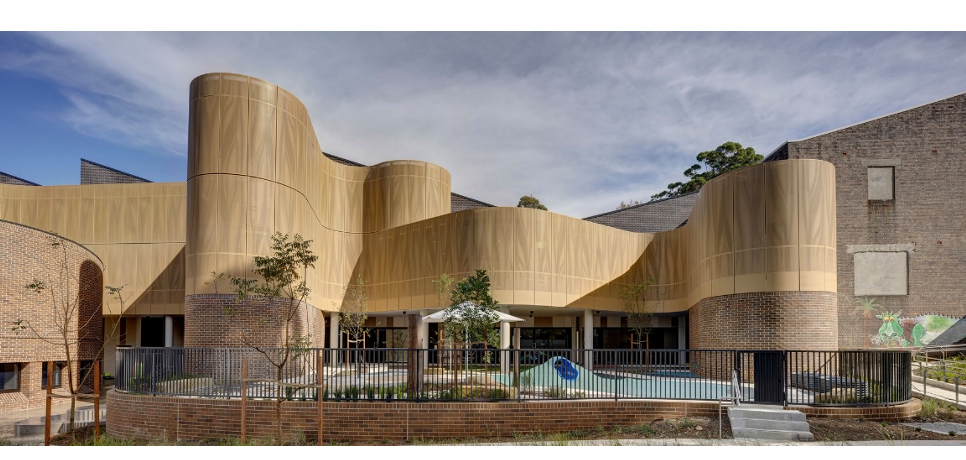
(Image credit: Darlington Public School, Sydney — DesignInc & Lacoste+Stevenson. Photograph via Wikimedia Commons)
I. A School That Begins by Paying Attention
Most school buildings speak first.
They announce order, discipline, instruction. They organise bodies into corridors and classrooms, signal authority through scale, and often rehearse a familiar architectural script in which learning is something administered rather than cultivated.
Darlington Public School does something far more difficult.
It listens first.
Designed by DesignInc in collaboration with Lacoste+Stevenson, and completed in 2023 on Gadigal Country in inner Sydney, the school does not treat education as an abstract programme to be housed. It treats it as a relationship — between children and place, between culture and curriculum, between architecture and Country.
This listening is not metaphorical. It is architectural.
II. Building on Country Without Erasure
The site sits within a dense urban context, layered with colonial history, institutional infrastructure, and contemporary multicultural life. To build a school here is to intervene not only physically, but historically.
Too often, architecture acknowledges Indigenous presence through symbolic gestures applied after the fact — motifs, artworks, plaques that sit politely beside a fundamentally unchanged spatial logic.
Darlington Public School rejects this model.
From the outset, Indigenous knowledge systems informed the project’s spatial organisation, material choices, and environmental strategies. The design process engaged with local Aboriginal perspectives not as consultation theatre, but as structural intelligence.
Country here is not referenced.
It is operational.
III. Form That Refuses Hierarchy
One of the most striking aspects of the school is its refusal of rigid hierarchy.
Rather than a dominant block surrounded by subordinate elements, the building unfolds as a series of interconnected forms scaled to children rather than institutions. Massing is broken down, circulation is legible, and spaces expand and contract gently rather than imposing authority.
This formal fragmentation does not produce confusion. It produces belonging.
Children move through the school intuitively, encountering thresholds that encourage curiosity rather than compliance. There is no single axis of power, no architectural insistence on where attention must be directed.
Learning here is not linear.
It is relational.
IV. Colour, Play, and Seriousness
The use of colour in Darlington Public School is often remarked upon — and frequently misunderstood.
This is not colour as decoration, nor as infantilisation. It is colour as pedagogical instrument.
Surfaces are calibrated to differentiate spaces, to aid orientation, to stimulate engagement without overwhelming. The palette draws from both natural references and contemporary learning environments, creating atmospheres that shift according to age, activity, and social context.
Importantly, colour is never applied arbitrarily. It is integrated with form, light, and material, reinforcing spatial legibility rather than masking it.
Playfulness here does not undermine seriousness.
It enables it.
V. Learning Spaces Without Walls as Dogma
Open-plan learning environments have become a fashionable orthodoxy in educational architecture — often with mixed results. When poorly executed, they generate noise, distraction, and pedagogical compromise.
Darlington Public School avoids this trap by refusing absolutes.
Spaces open and close as needed. Transparency is balanced with enclosure. Acoustic control is treated as essential rather than secondary. Teachers retain agency over how learning environments operate.
The architecture does not prescribe a single educational philosophy.
It accommodates plurality.
This flexibility is not neutral. It acknowledges that teaching is a craft, not a script.
VI. Climate as Quiet Curriculum
Environmental performance is embedded throughout the building, but never announced as spectacle.
Natural ventilation is prioritised. Shading devices are integrated rather than appended. Daylight is carefully modulated to avoid glare while maintaining connection to the outdoors. Materials are selected for durability, low toxicity, and long-term maintenance rather than visual novelty.
Sustainability here is not framed as innovation.
It is framed as responsibility.
Children learn, implicitly, that buildings respond to climate rather than dominate it — that comfort can be achieved through intelligence rather than excess.
VII. The Schoolyard as Cultural Space
The outdoor spaces of Darlington Public School are not residual zones left over after construction. They are central to the project’s identity.
Courtyards, play areas, and gathering spaces are designed as extensions of learning rather than escapes from it. Landscape elements reference Indigenous relationships to land without literal representation, encouraging respect through experience rather than instruction.
The schoolyard becomes a place where physical movement, social interaction, and environmental awareness intersect.
Education here does not stop at the classroom door.
It expands outward
VIII. Safety Without Fortress Architecture
In an era increasingly defined by security anxiety, many schools adopt defensive architectures — fences, surveillance, hard boundaries that communicate mistrust.
Darlington Public School takes a different path.
Safety is achieved through visibility, legibility, and community integration rather than fortification. Boundaries exist, but they are permeable and humane. The school feels protected without feeling closed.
This balance is not accidental. It reflects a belief that safety emerges from careful design, not architectural aggression.
IX. Architecture as Cultural Pedagogy
Perhaps the most significant achievement of Darlington Public School is how it teaches without instruction.
Children learn, through daily experience, that:
- multiple knowledge systems can coexist
- architecture can respond to Country respectfully
- learning environments need not be authoritarian
- sustainability is ordinary, not exceptional
- difference is spatially supported, not erased
These lessons are not written on walls.
They are inhabited.
X. Recognition Without Compromise
In 2024, Darlington Public School was named World Building of the Year. The accolade brought global attention — and with it, the risk of misinterpretation.
This is not a building that succeeds because it photographs well or aligns neatly with global trends. It succeeds because it is situated, precise, and ethically grounded.
Its international recognition does not flatten its specificity. It amplifies the argument that local intelligence, when taken seriously, produces architecture of global relevance
XI. Against the Export Model of Educational Design
Educational architecture is often exported as typology — standardised, branded, and detached from place.
Darlington Public School resists this logic entirely.
Its success does not lie in replicability, but in attentiveness. It demonstrates that good school architecture cannot be copy-pasted. It must be listened into existence.
XII. Conclusion: A School That Knows Where It Is
Darlington Public School does not claim to resolve the complexities of education, reconciliation, or sustainability.
What it does instead is more disciplined.
It creates a setting in which these conversations can occur honestly — spatially, daily, without performance.
It shows that architecture, when it listens carefully enough, can become a form of respect.
Not symbolic respect.
Not declarative respect.
But lived, ordinary, enduring respect.
You May also like

By samantha stafford


By Rojina Bohora