An Excuse To Learn Spanish or Something Far More Meaningful?
By Sam Stafford & Carolina Berghinz
Publication Date: 08th December 2025
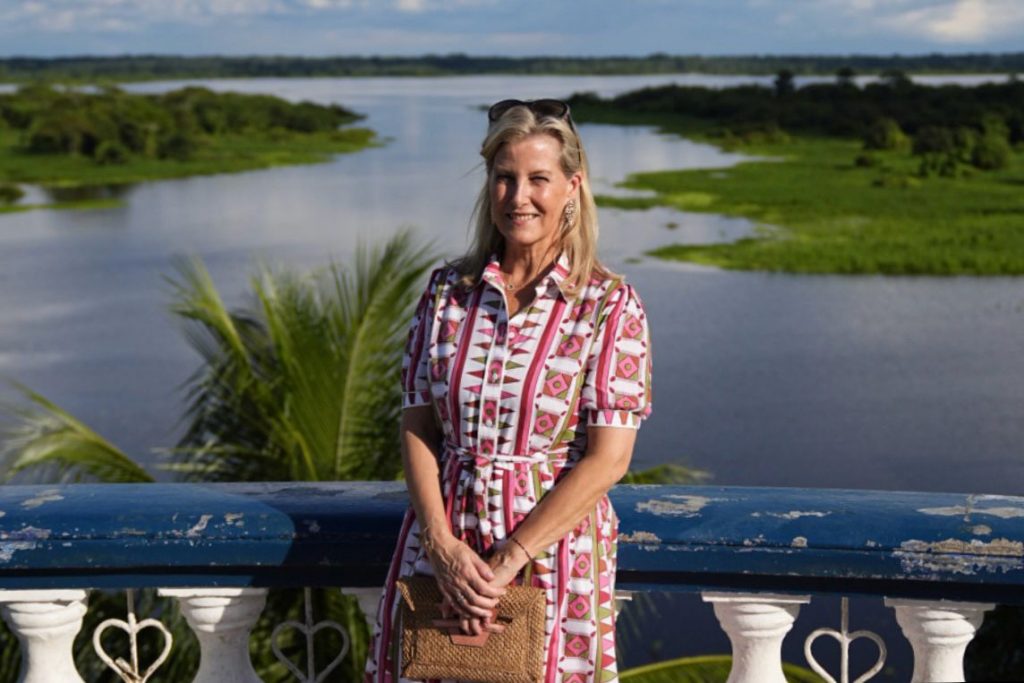
(Image Credit: Royal Family Instagram)
Duchess Sophie married to the Duke of Edinburgh visits South America in the manner of someone who understands that the highest form of arrival is not visibility, but attentiveness.
This is not a journey designed to sparkle at the edge of the news cycle. It is a passage of weight and grain, a slow traversal across histories that do not yield their meaning to speed. The Duchess does not come trailing the rhetoric of urgency; she comes with the discipline of listening. And listening, in this geography, begins with the humility to enter another language knowing it will not bend easily to one’s mouth.
At the centre of the visit stands Sophie Duchess of Edinburgh, a figure whose public life has been shaped not by the theatrical assertion of relevance but by the quieter accumulation of trust. In a century addicted to amplification, she practices reduction. Where others clarify themselves through repetition, she clarifies herself through restraint.
Language as Moral Posture
To learn Spanish at this level of public responsibility is not an accessory skill. It is an ethical posture. Adult language learning is a rehearsal in modesty: each mis-conjugation a small confession of limits; each pause an acknowledgement that meaning lives beyond fluency. For a senior royal, this is not charm. It is philosophy enacted in breath and syllable.
Spanish here is not employed as performance. It is extended as recognition. The Duchess’s effort declares—without ever stating—that diplomacy which insists upon being addressed only in English risks becoming a historical echo rather than a contemporary conversation. Language, in this sense, becomes the architecture of respect: invisible when done well, load-bearing always.
A Continent That Remembers
South America is not indifferent to intention. It remembers being spoken about more often than being spoken with. It recognises the difference between attention that extracts and attention that accompanies. The Duchess’s presence, measured and unhurried, aligns unmistakably with the latter.
Her engagements unfold not as events but as encounters. There is time allowed for sentences to complete themselves. For silence to carry information. For complexity to resist simplification. Long before microphones arrive, this region learned to read posture, cadence, and patience as fluently as words. The reception she meets is therefore not ceremonial warmth but something more exacting: reciprocal seriousness.
Her longstanding work with women affected by violence finds in South America not a borrowed cause but a resonant terrain—one shaped by endurance, reform, and the generational labour of courage. She does not import a framework; she recognises an existing one, and steps into it with care.
Royalty Without Illusion
Married to Prince Edward, Duke of Edinburgh, Sophie embodies a model of monarchy that has quietly matured away from spectacle and toward service. This is royalty as continuity rather than interruption; as reliability rather than reinvention.
The South American visit reveals something essential about her public philosophy: that relevance is not claimed, it is accrued. And that modernity is not pursued by gesture, but earned through conduct. She does not announce values; she submits them to context and lets them hold.
Learning Spanish, in this light, is not symbolic. It is structural. It signals an understanding that Britain’s contemporary presence in the world is not sustained by historical memory alone, but by present-day fluency—linguistic, cultural, moral.
Something Far More Meaningful
It would be easy, and comforting, to describe this journey as an excuse to learn Spanish. But that would be to mistake the surface for the substance.
What unfolds instead is a demonstration of how power behaves when it no longer needs to prove itself. A reminder that diplomacy need not dominate to endure. That the most persuasive authority often speaks softly, imperfectly, and with evident effort.
In the end, the Duchess of Edinburgh’s South American visit leaves behind no headline designed to travel fast. It leaves something rarer: a recalibration of expectations. That leadership may still be quiet. That respect may still be practiced rather than proclaimed. And that meaning, when it truly arrives, often does so disguised as the simple courage to speak another language badly—until, one day, it begins to speak back.
You May also like
By Sam Stafford