
The Dome That Chose Silence Over Spectacle
By Rojina Bohara
Publication Date 6th January 2026; 15:49 GMT
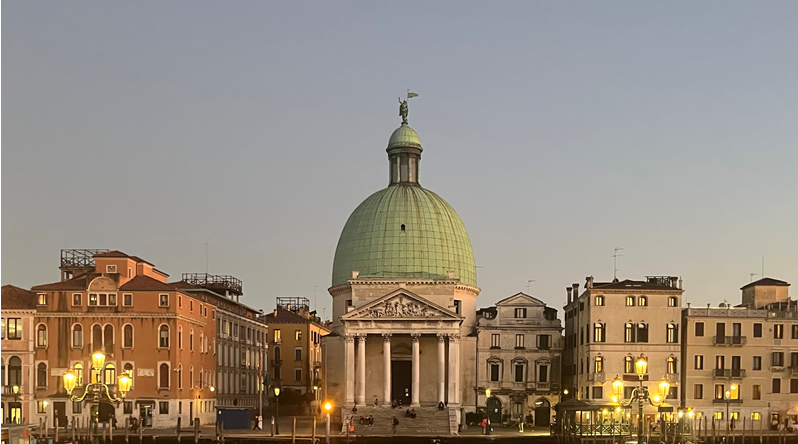
Venice has never lacked for confidence.
It has dazzled with mosaics, intoxicated with façades, seduced with reflections so ornate they verge on hallucination. In a city where architecture learned early how to perform, San Simeone Piccolo commits a far rarer, more dangerous act:
It withholds.
Seen here at dusk — when the lagoon becomes a sheet of burnished metal and the city exhales — the church stands not as a climax, but as a counterweight. Across from the chaos of arrivals at Santa Lucia station, where the modern world spills noisily into Venice, San Simeone Piccolo does not compete.
It waits.
A Classical Intrusion That Became a Moral Anchor
Built in the 18th century, San Simeone Piccolo is a deliberate architectural anomaly in Venice: unapologetically Neoclassical, emphatically Roman, almost stubbornly continental in a city that usually prefers Byzantine shimmer and Gothic lace.
Its portico — severe, frontal, disciplined — could stand in a Roman forum without explanation. Corinthian columns rise without flourish, not to impress but to declare alignment with an older, sterner architectural lineage: reason, proportion, restraint.
This was not imitation.
It was correction.
Venice, late in its imperial life, did something extraordinary here: it paused its own aesthetic intoxication and reached back toward order.
The Dome: Authority Without Ornament
The dome is the building’s true thesis.
Green with age, smooth to the point of asceticism, it rises not theatrically but inevitably — a hemisphere asserting that geometry alone can command reverence. There are no ribs shouting upward, no lantern vying for attention. The dome does not gesture toward heaven.
It assumes it.
Topped by a statue that reads less as triumph than vigilance, the structure speaks in a register Venice rarely uses: certainty without seduction.
This is power without sparkle.
Faith without choreography.
A Church That Faces the City, Not the Lagoon
Most Venetian churches orient themselves inward or toward water as spectacle. San Simeone Piccolo does something more confrontational: it faces the threshold.
It greets the newcomer — not with flourish, but with judgment.
Step off the train, and before the cafés, before the vaporetto, before the carnival of Venetian surfaces, this church meets you eye-to-eye and says, in stone:
Understand proportion before pleasure.
Understand silence before beauty.
This positioning is not accidental. It is architectural pedagogy.
Symmetry as Discipline
The façade is ruthlessly symmetrical. No indulgence breaks the order. The pediment does not narrate excess; it resolves structure. The stairs do not dramatize ascent; they prepare it.
In a city built on instability — wooden piles driven into mud, palazzi floating by consensus rather than certainty — San Simeone Piccolo is an act of architectural defiance.
It insists that clarity can exist even here.
Venice’s Most Misunderstood Church
Tourists pass it daily.
Photographers frame it.
Few linger.
And that is precisely the point.
San Simeone Piccolo does not reward speed. It is not photogenic in the way Venice has trained us to expect. It requires the viewer to slow down enough to feel the gravity of proportion, the authority of mass, the calm that arrives when architecture stops asking for attention.
It is Venice refusing to perform.
A Counter-Architecture for an Overstimulated World
In an era addicted to spectacle — to parametric excess, to algorithmic novelty, to buildings that beg to be photographed rather than inhabited — San Simeone Piccolo feels almost subversive.
It offers:
- no visual sugar,
- no narrative indulgence,
- no easy emotional cue.
Instead, it offers composure.
It reminds us that architecture once existed not to excite, but to steady. Not to distract, but to orient. Not to entertain, but to endure.
The Final Reckoning
If St Mark’s Basilica is Venice’s voice,
and the Doge’s Palace its politics,
then San Simeone Piccolo is its conscience.
Quiet.
Unyielding.
Perfectly balanced.
This image captures that truth exquisitely: the dome rising as light fades, the city receding into domestic scale, the lamps glowing low, human, provisional — while the architecture remains.
Not louder than Venice.
Not richer than Venice.
But in its own way, wiser.
And perhaps that is the highest achievement architecture can still claim.
You May also like
By Rojina Bohora