Is The Princess Royal Becoming The Most Powerful Female Figure In The World?
By Carolina Berghinz
Publication Date 5th January 2026: 10:49 GMT
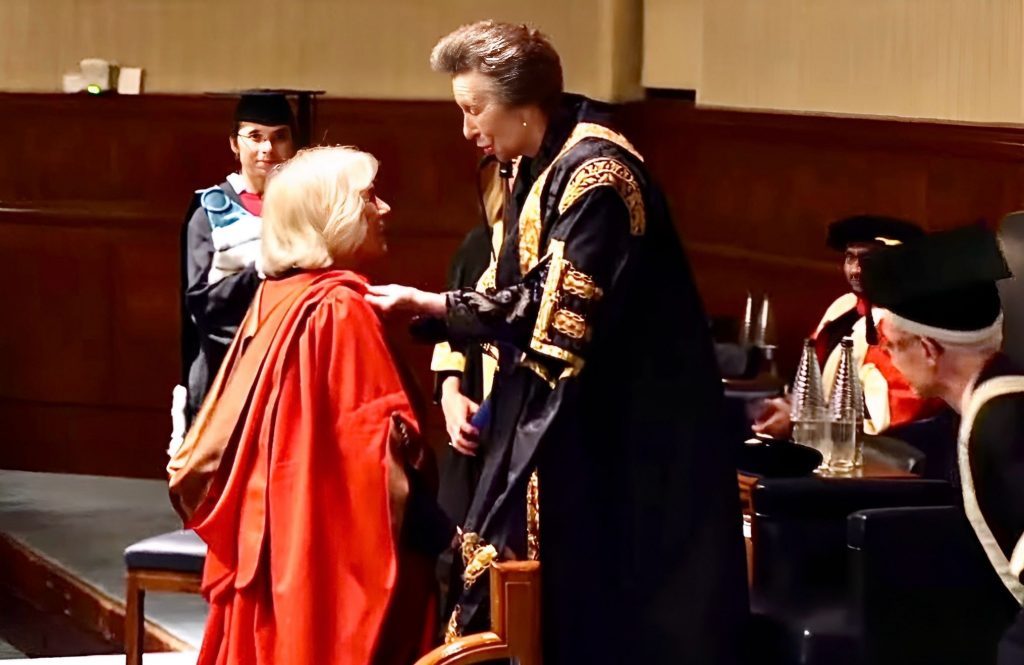
(Image Credit: Royalty Channel YouTube)
A Study in Authority Without Crown, Power Without Performance
Power, in the modern constitutional world, has become a misunderstood concept. It is no longer forged in crowns alone, nor sustained by ritual repetition, nor even guaranteed by proximity to a throne. Power now resides where competence, continuity, and institutional trust converge. And by those measures—measured not sentimentally but analytically Princess Anne occupies a position unmatched by any female royal alive today.
This is not hyperbole. It is structural reality.
The Last Crowns Standing
Only a vanishingly small number of monarchies still practise the theological act of physical crowning—the moment when authority is not merely proclaimed, but symbolically transferred through consecrated object and gesture. Britain remains one. Beyond it, one finds rare outliers such as Eswatini , an absolute monarchy with a population of approximately 1.2 million and a doctoral-level educational footprint so limited that the number of PhD holders does not exceed a few hundred nationwide, representing well under 0.05 % of the population.
This contrast matters. It exposes the distinction between ceremonial survival and institutional sophistication. Britain’s coronation endures not because it resists modernity, but because it has mastered symbolic compression: meaning concentrated, authority dispersed.
And within that evolved system, real power migrates—not upward, but outward.
Elizabeth II’s Long Game
Only a vanishingly small number of monarchies still practise the theological act of physical cro
Queen Elizabeth II was not merely a constitutional monarch; she was an institutional strategist. Her greatest talent lay in understanding who would matter when ritual inevitably hollowed. Her preparation of Princess Anne was neither accidental nor sentimental.
Princess Anne was never shaped to charm. She was shaped to function.
The late Queen ensured that her daughter’s role would be grounded in operational authority rather than ceremonial subordination. This is the context—often misunderstood—behind Princess Anne’s unique standing at the coronation of King Charles III. No constitutional amendment was required; the monarchy operates as much on precedent and prerogative as on statute. Anne’s position was already settled decades earlier: she was to be a principal, not an accessory.
Her appointment as a Counsellor of State for life—formalised in the 2022 legislation—was not honorary. It was a constitutional acknowledgment of reality: should the machinery of monarchy need to run without spectacle, Princess Anne is one of the few figures trusted to keep it operational.
That is power.
ning—the moment when authority is not merely proclaimed, but symbolically transferred through consecrated object and gesture. Britain remains one. Beyond it, one finds rare outliers such as Eswatini, an absolute monarchy with a population of approximately 1.2 million and a doctoral-level educational footprint so limited that the number of PhD holders does not exceed a few hundred nationwide, representing well under 0.05 % of the population.
This contrast matters. It exposes the distinction between ceremonial survival and institutional sophistication. Britain’s coronation endures not because it resists modernity, but because it has mastered symbolic compression: meaning concentrated, authority dispersed.
And within that evolved system, real power migrates—not upward, but outward.
The Coronation: Authority Made Visible
At the coronation, Princess Anne did not bow theatrically, nor did she seek exemption ostentatiously. She appeared as Gold Stick-in-Waiting, wearing uniform, mounted, positioned physically and symbolically as guardian rather than supplicant. Any suggestion of defiance misunderstands both Anne and the Crown.
She does not reject hierarchy.
She embodies it.
Queen Camilla herself has publicly benefited from Anne’s strict adherence to protocol—on occasions Anne has insisted on Camilla’s precedence even when Camilla attempted informality. This is not rivalry. It is institutional discipline.
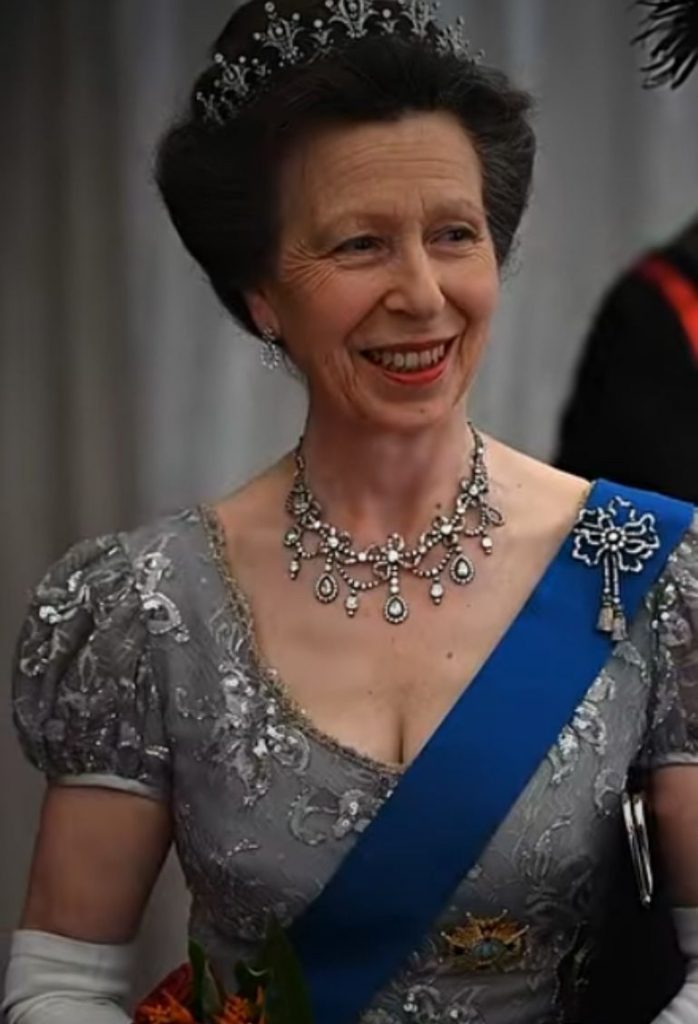
(Image Credit: YouTube The Royals 007 Channel)
Jewels as Instruments, Not Ornament
Nowhere is Princess Anne’s unique standing more evident than in the jewels associated with her—objects too often dismissed as decoration, but in monarchy function as assignments of trust.
Among the most significant:
- The Aquamarine Pineflower Tiara – commissioned by King George VI, worn by Queen Elizabeth the Queen Mother, and later entrusted to Anne. It is a tiara associated not with glamour, but with matriarchal continuity and endurance.
- Queen Elizabeth II’s pearls – worn by Anne at moments of international and emotional gravity, signalling not inheritance of taste, but inheritance of authority.
- Historic sapphire and diamond brooches originating in Queen Mary’s collection – worn by Anne with almost monastic restraint, reinforcing her role as custodian rather than consumer of royal legacy.
These are not jewels passed to favourites. They are jewels passed to reliable hands.
Why She Is Unmatched
Princess Anne undertakes more engagements annually than any other senior royal. She is trusted by governments, relied upon by the armed forces, respected by charities, and largely immune to scandal, trend, or reinvention. She does not explain the monarchy to the public; she executes it.
In an era obsessed with relatability, she offers credibility.
In a culture addicted to performance, she delivers precision.
This is why she has become, almost without announcement, the most powerful female figure in royalty today.
Not because she reigns.
Not because she dazzles.
But because if the monarchy were reduced to its essentials—duty, continuity, trust—she would remain standing when the pageantry fell away.
The Crown Beyond the Crown
History may yet record that the most consequential royal woman of the post-Elizabethan era was not a queen, not a consort, and not an icon—but a Princess Royal who proved that monarchy’s future would depend not on who is crowned, but what and who else encompasses the sacred head of state.
And in that future, Princess Anne already reigns—quietly, decisively, and without need of a throne.
You May also like

By Anne Canal

By Anne Canal
By Rojina&Samantha Stafford