
Hôtel de Ville, Paris
By Rojina Bohora
Publication date 17th November 2025: 12:45
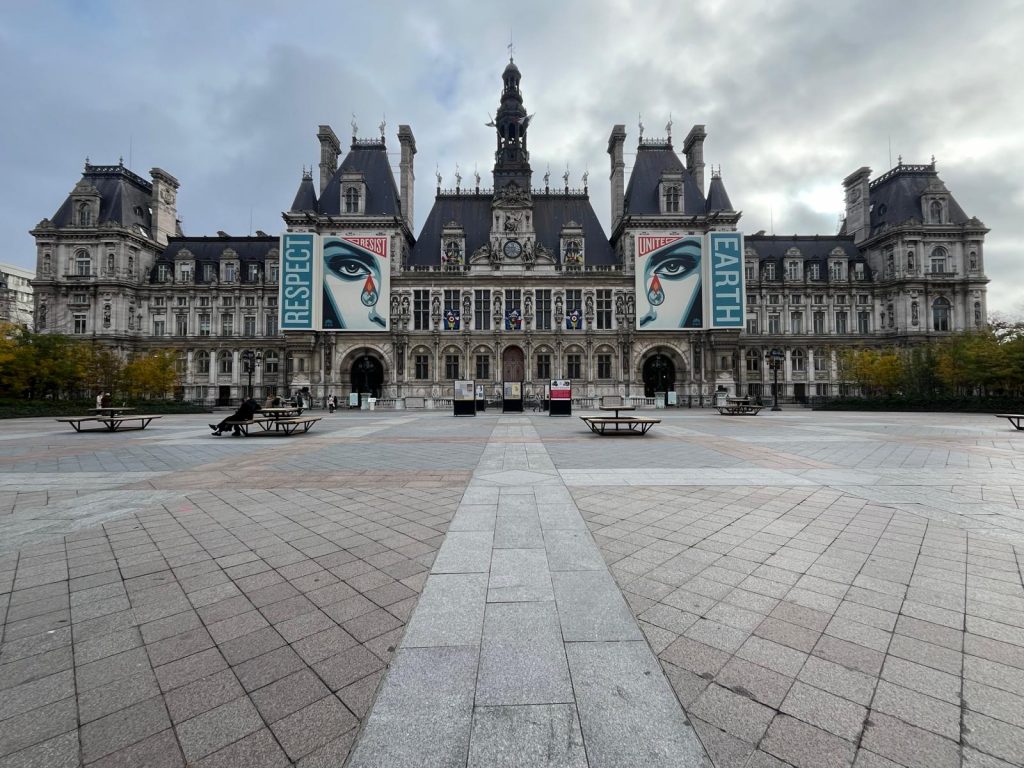
(Image Credit: Georgia Shomber)
Architecture as the Last Argument of the Republic
Some buildings are designed to be admired.
Others are designed to be obeyed.
A very rare few are designed to outlast belief itself.
Paris’s Hôtel de Ville belongs to that final, vanishing category: architecture not as shelter, nor spectacle, nor even symbol — but as constitutional matter. It is a building that does not merely represent civic authority; it disciplines it.
To stand before it — as this image invites us to do, directly, symmetrically, without theatrical angle or flattering distortion — is to confront a truth most modern cities have forgotten:
that power, if it wishes to endure, must first learn how to stand still.
A Building That Refuses the Ego
The Hôtel de Ville does not seduce.
It does not perform.
It does not reach for transcendence.
Instead, it presents itself with a confidence so settled it borders on indifference.
This is not accidental. Its neo-Renaissance skin — reconstructed after its deliberate destruction during the Paris Commune — is not revivalist nostalgia but ideological repair. Paris did not rebuild the Hôtel de Ville to beautify itself; it rebuilt it to reassert continuity after the most violent rupture imaginable: a moment when citizens burned the physical embodiment of their own governance.
The lesson embedded in the stone is mercilessly clear:
institutions may fall; the civic order must not.
The Façade as a Civic Manuscript
Look closely and the façade reads less like a wall than a text.
Each bay is grammatical.
Each window is punctuated.
Each statue is a citation.
There are no monarchs enthroned here. No saints interceding. Instead, the upper registers are populated by sculpted embodiments of human competence — architects, scientists, jurists, artists — figures chosen not for divine favour or bloodline, but for contribution.
This is one of the most radical architectural statements in Europe:
a building that canonises capability.
The central clock does not glorify time — it enforces it. It is a reminder, carved into the skyline, that authority is leased, not owned. That every decision made inside these walls is already aging toward judgment.
Symmetry as Ethical Technology
The symmetry is absolute — and unforgiving.
In lesser buildings, symmetry flatters.
Here, it restrains.
Nothing protrudes. Nothing dominates. The central pavilion does not command the wings; it negotiates with them. Power is distributed laterally, not vertically — a spatial analogue of republican governance itself.
This is why the Hôtel de Ville feels calm even when history is not.
Its geometry teaches equilibrium.
Its repetition teaches patience.
Its scale teaches proportion — not between buildings, but between state and citizen.
The Square: An Empty Sentence Waiting to Be Spoken
The forecourt is one of the most underestimated architectural gestures in Europe.
It is not landscaped.
It is not monumentalised.
It is deliberately available.
This emptiness is not absence; it is invitation. The square is a civic blank page, capable of holding festivals, protests, grief, joy, silence — without rewriting itself each time.
That is architectural maturity.
A government confident in its legitimacy does not clutter the space where citizens assemble. It clears it.
Modern Banners, Ancient Confidence
The contemporary banners — RESPECT, UNITÉ, EARTH — do not overwhelm the façade. They cannot. The building absorbs them as effortlessly as a cathedral absorbs candles.
This is crucial: the Hôtel de Ville does not borrow relevance from modern causes. It allows those causes to temporarily speak through it, knowing the stone will remain when the slogans evolve.
Only buildings secure in their purpose can afford to host the language of the present without being redefined by it.
Why This Building Still Matters
Most modern civic architecture is either apologetic or aggressive — glass boxes pleading transparency, or monumental shells asserting dominance.
The Hôtel de Ville does neither.
It assumes:
•that governance will continue,
•that citizens will return,
•that history will repeat its arguments,
•and that the building will still be standing when it does.
This is architecture with temporal authority — not loud enough to intimidate the present, not fragile enough to fear the future.
The Final Measure
If Versailles teaches us how absolute power wished to be seen,
and the Eiffel Tower teaches us how modernity wished to announce itself,
then the Hôtel de Ville teaches us something far rarer:
how a republic survives its own passions.
It is not Paris’s most photographed building.
It is not Paris’s most romantic building.
But it may well be Paris’s most serious.
And in an era of fleeting governments, disposable ideologies, and performative transparency, seriousness — rendered in stone — may be the most radical architectural act of all.