
THE GREAT REVERSAL
By Verdina Sea
Publication 9th December 2025: 9:57 GMT
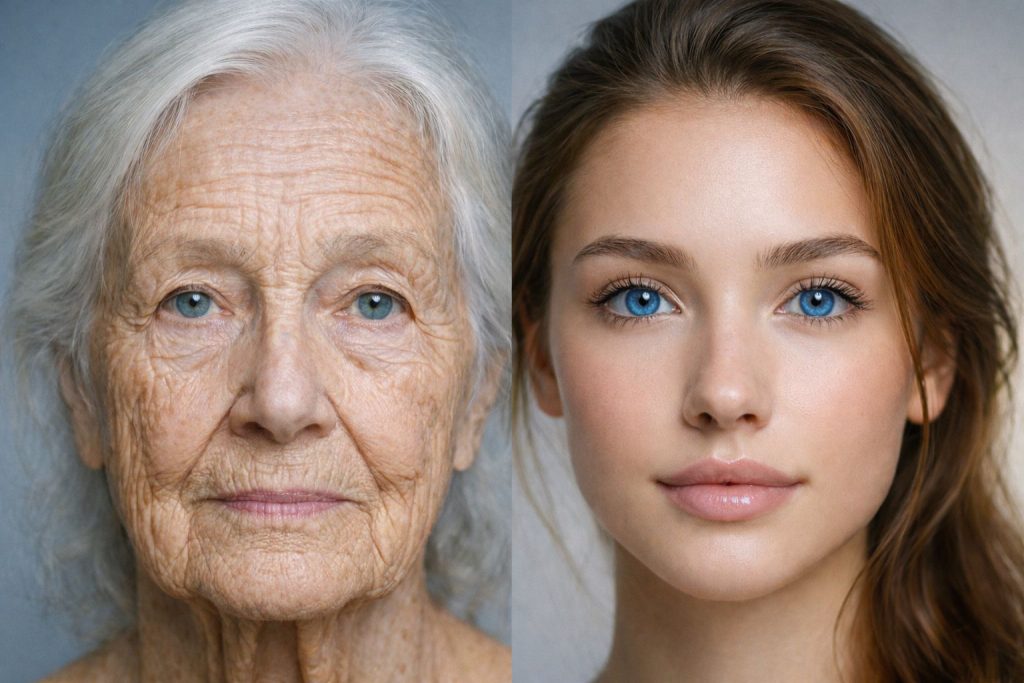
(Image Credit: publicdomainpictures.net)
How Human Rejuvenation Is Becoming the Most Consequential Scientific Frontier of the 21st Century
And Why the Distance Between the Two Faces Above May One Day Be Crossable
The image presents two ends of the same biological spectrum:
one face marked by time; one sculpted by youth.
Across human history, these two physiognomies were separated by an irreversible one-way current — a steady drift toward entropy, cellular damage, stem-cell exhaustion, and systemic decline.
But for the first time in the story of our species, scientists are beginning to ask not “How do we slow this down?” but “How do we undo it?”
Rejuvenation is no longer mythological.
It is mathematical, molecular, programmable.
The question is no longer if human rejuvenation will occur.
The question is how complete it can become.
Below is a panoramic, scientifically rich, globally comprehensive examination of every contemporary and near-future technology capable of turning the left-hand image into something approximating the right.
- THE CELLULAR RESET — The Revolution That Started With Yamanaka
The single most important discovery in the rejuvenation field came from Shinya Yamanaka in 2006–2007:
the OSKM factors (Oct4, Sox2, Klf4, c-Myc), which allow adult cells to be reset to pluripotency.
The near-future evolution of this is not full cellular reprogramming (which erases identity and can cause cancer), but partial reprogramming, in which cells regain youthful function without losing their specialised identity.
Breakthroughs include:
- Partial Reprogramming Gene Therapy (PRGT)
Delivered through AAV vectors or lipid nanoparticles, these therapies pulse OSKM for mere hours or days — just enough to reverse:
- mitochondrial dysfunction
- epigenetic drift
- telomere erosion
- misfolded proteome accumulation
- stem-cell exhaustion
In mice, partial reprogramming has reversed biological age by 20–40% in some tissues.
Human trials are emerging.
- EPIGENETIC REPAIR — Turning Back the Aging Clock That Sits Above Our Genes
Aging is now widely accepted as the progressive loss of epigenetic information.
The “scratches” on the genome’s vinyl record distort how genes are read.
Today, entire fields are emerging to polish that record:
- DNA Methylation Editing
CRISPR-based and CRISPR-free tools now allow scientists to add or erase methyl groups in specific genomic neighbourhoods.
- Histone Modification Therapies
Drugs that restore youthful chromatin architecture (e.g., HDAC inhibitors, BET inhibitors) can rewind gene expression programs.
- Epigenetic Age Eraser Molecules
Compounds such as:
- α-ketoglutarate
- NAD+ boosters
- SIRT activators
- TET enzyme enhancers
…all aim to restore the youthful epigenetic landscape.
Within 10–15 years, epigenetic rejuvenation may become the primary anti-aging therapy worldwide.
III. STEM-CELL RENEWAL — The Body’s Internal Regeneration Engine
The difference between the left and right faces is essentially stem-cell vitality.
Near-future solutions include:
- Ex Vivo Expansion of Autologous Stem Cells
Bone-marrow or adipose-derived stem cells expanded to youthful potency, then re-infused.
- Induced Tissue-Specific Stem Cells
Scientists can now transform ordinary blood cells into:
- skin stem cells
- muscle satellite cells
- retinal progenitors
- neural precursors
The implications for facial rejuvenation alone are vast.
- Whole-Organ Regeneration Bioreactors
Early systems allow regeneration of:
- cartilage
- ligaments
- patches of myocardium
- full-thickness skin grafts
The long-term goal: regenerate entire organs at youthful capacity.
- SENOLYTICS — Clearing the “Zombie Cells” That Drive Aging
Senescent cells are one of the main causes of:
- wrinkles
- chronic inflammation
- organ dysfunction
- decreased collagen production
- systemic frailty
Senolytics are drugs that selectively destroy these dysfunctional cells.
Major candidates include:
- Dasatinib + Quercetin
- Fisetin
- FOXO4-DRI peptide
- Navitoclax
- Emerging antibody-guided senolytics
In mice, senolytic treatment yields:
- 25–35% increased lifespan
- dramatically improved skin elasticity
- renewal of immune and vascular function
Human applications are imminent.
- BODY-WIDE YOUTH FACTORS — Young Blood, Dilution, and Recombinant Molecules
While sensationalised, parabiosis research revealed something astonishing:
It is not young blood that rejuvenates.
It is old blood that inhibits youth.
Thus two parallel therapies have emerged:
- Plasma Dilution Therapies
By diluting pro-inflammatory factors in old plasma (e.g., TGF-β, CCL11), tissues regain youthful behaviour.
- Recombinant Youth Factors
Scientists are isolating individual molecules that restore youthful gene expression — such as GDF11 and TIMP2.
Future therapies may involve periodic infusions of purified youth molecules rather than whole plasma.
- TELOMERE RESTORATION — Protecting Chromosomal Youth
Telomeres shorten with age, reducing cell function and increasing DNA fragility.
Cutting-edge telomere-lengthening methods:
- hTERT gene therapy
- modified mRNA delivery
- telomerase-activating peptides
- CRISPR-based telomere repair
In human cells, telomerase therapy has reversed the biological age of fibroblasts by decades.
VII. SKIN REJUVENATION — The Visible Frontier (and the Easiest to Transform)
Modern dermatology is advancing at shocking speed.
- Regenerative Skin Bioprinting
Portable bioprinters that deposit live stem cells directly onto areas of age-related loss.
- Fat-Grafting 2.0
Nanofat, microfat, and SVF (stromal vascular fraction) deliver vibrant stem cells to the dermis.
- Exosome Therapy
Extracellular vesicles derived from stem cells that trigger collagen production 2–5× baseline.
- RNA Cosmetics
Topical siRNA or mRNA correcting age-related gene expression in skin.
Within 5 years, the cosmetic dermatology of today will look archaic.
VIII. NEAR-FUTURE BREAKTHROUGHS THAT BORDER ON SCIENCE FICTION (BUT AREN’T)
- Full-Body Cellular Rejuvenation Cycles
A three-step medical protocol:
- senolytic purge
- partial reprogramming
- youthful immune reboot
This could plausibly reduce biological age by 5–10 years per cycle.
- Synthetic Immunity Reset
Replacing aged immune cells with lab-grown youthful T-cells, NK-cells, and macrophages.
- In Situ Organ Rejuvenation Nanobots
DNA-origami nanorobots capable of:
- repairing mitochondrial DNA
- delivering RNA instructions
- clearing protein aggregates
These technologies already exist in prototype form.
- Pan-Tissue Epigenetic Resetting Devices
Wearable or injectable devices that release timed pulses of molecules triggering youthful gene-expression states body-wide.
- THE COMPARISON TO THE IMAGE — HOW CLOSE CAN WE GET?
The distance between the two faces above is:
- structural (bone, fat, collagen)
- cellular (senescence, mitochondrial decline)
- epigenetic (gene-expression drift)
- systemic (immune and hormonal aging)
Based on current and near-future science, we can expect:
Within 5–10 years:
- reversal of 10–15 years of biological age
- drastically improved skin, muscle tone, and energy
- retinal, vascular, and immune rejuvenation
Within 15–25 years:
- 20–40 years of rejuvenation possible
- entire organ systems restored
- youthful gene-expression patterns maintained
- “reset cycles” done periodically like dental cleanings
Within 30–50 years:
If no regulatory or ethical constraints slow progress:
The two ends of the image may become medically traversable.
Not immortality.
Not perfection.
But robust, repeatable, scientifically controlled rejuvenation that could make a 75-year-old physiologically resemble a 35-year-old.
Human history has no precedent for this.
- FINAL REFLECTION — The Last Generation to Age in the Traditional Sense
The faces in the image represent what humanity has always assumed to be destiny.
But destiny is becoming negotiable.
Science is converging on a single truth:
Aging is not an inevitability — it is a solvable spectrum of molecular errors.
And humans, for the first time, are learning how to correct them.
We are not entering the era of anti-aging.
We are entering the era of Age Reversal.
And the distance between the old and the young is shrinking — year by year, pathway by pathway, gene by gene.
The greatest human transformation of the 21st century has already begun.
You May also like

By Tayyaba Zahid
By Tayyaba Zahid
By Rose Polpi