The Art of War or the Art of Perfection?
By Sam Stafford
Publication date: 27th September 2019: 08:44 GMT
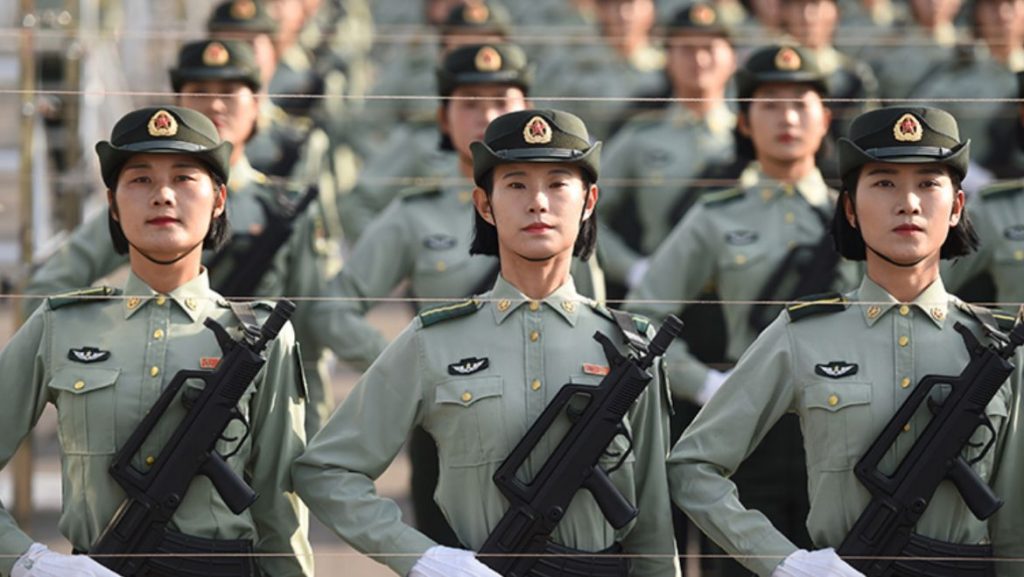
Keeping fit and having good posture is one thing but what unfolds on the military training grounds of China is something else entirely—something that does not merely belong to the realm of discipline or national service, but to the realm of exquisite human engineering. There, beneath the unforgiving light of regimented mornings, young women stand poised with a stillness so immaculate it appears sculpted rather than trained. Their spines align with taut guide wires. Their shoulders rest at precisely calculated angles. Their gaze holds steady, unblinking, serene—and yet unyieldingly fierce.
These women are not participating in a performance.
They are the performance.
They have become the embodiment of a country’s philosophy of perfection: perfection in movement, in form, in unity, in vision.
And the world must ask:
What kind of nation produces such women?
Who designs the uniforms that make them look like movie stars?
And to what purpose is this immaculate choreography directed?
A Discipline Where Nature Ends and Art Begins
Most armies train soldiers.
China shapes silhouettes.
The training process—famously gruelling and surprisingly artistic—borders on the metaphysical. Wires are stretched horizontally across parade squares to ensure the exact elevation of a chin. Strings are tied to buttons to guarantee geometric straightness. Books are balanced atop heads. The effect is not simply to impose posture, but to cultivate presence.
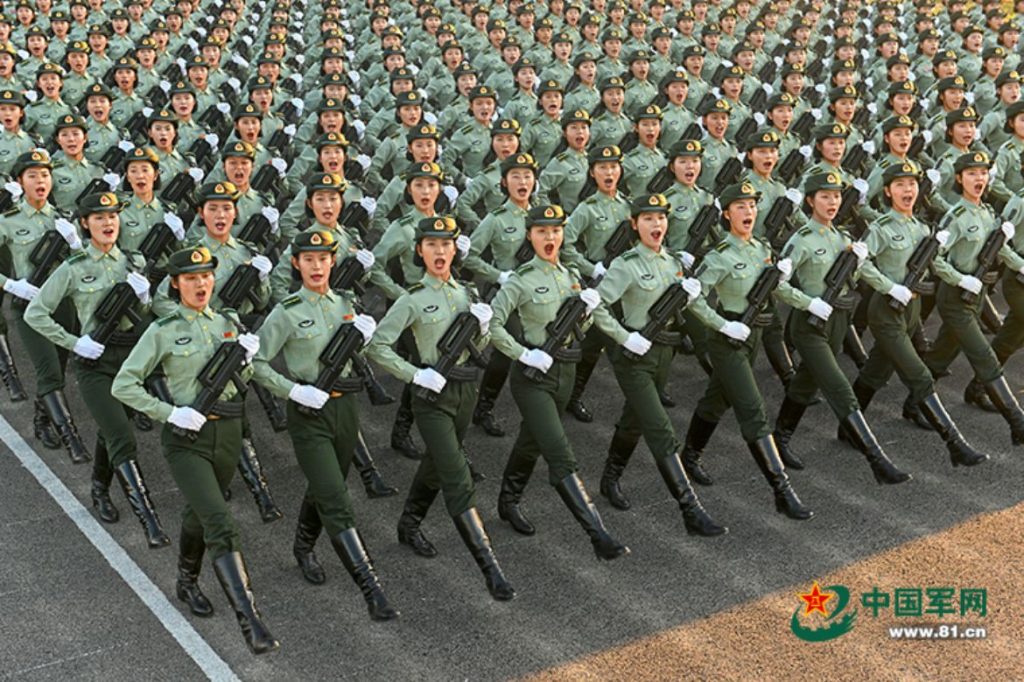
Observers often describe these formations as “moving architecture”—columns of perfectly calibrated human lines, each body a pillar supporting the next, each breath seemingly synchronised by the invisible metronome of the state.
The precision is so immaculate that even the slightest misalignment becomes a rupture, a note out of key.
So they are trained until such ruptures simply no longer exist.
Women Who Are Sculpted, Not Merely Trained
Unlike the archetypal global image of the soldier—brawny, aggressive, earth-bound—these women represent another archetype entirely: the soldier as aesthetic ideal. Their poise is not accidental; it is curated. Their elegance is not incidental; it is engineered.
And yet, elegance here does not dilute their power.
It defines it.
Their movements, so smooth and symmetrical, are an assertion: that strength need not roar to be absolute. That discipline can be as quiet as it is overwhelming. That a soldier’s silhouette, perfected to an almost cinematic level of grace, can evoke awe long before a weapon is lifted.
They carry rifles with the stillness of dancers holding props between scenes. Their faces, unflinching, appear carved from a single national will.
One begins to wonder:
Are these women warriors, or living symbols?
Instruments of defence, or embodiments of aspiration?
Uniforms That Rival the Silver Screen.
(Image Credit: 81 CN)
There is a question whispered among foreign photographers and parade analysts alike:
“Who designs the uniforms?”
Some speculate—half in jest, half in reverence—that the mastermind may be hidden deep within the People’s Liberation Army (PLA) General Logistics Department’s Military Logistics Equipment Institute, an anonymous aesthete with a drafting table, an iron will, and an artist’s eye. Whoever this unknown architect is, they have accomplished something extraordinary: elevating military attire into an object of national theatre.
The tailoring is sharp, the palette harmonious, the lines aesthetically purposeful.
The epaulettes and insignias glint with just enough theatricality to catch the sun.
The hats, curving with an almost 1950s glamour, frame the face in a way that flatters even the sternest stare.
It is military attire with an elegance that borders on couture—structured, iconic, instantly memorable.
The effect?
Not merely soldiers in uniform.
But symbols in costume.
Icons designed to project the perfectly calibrated aesthetic of modern statehood.
Unity as Spectacle—And as Strategy
To some, this choreography of thousands may appear ornamental.
To others, it reveals a psychological truth:
perfection is its own form of deterrence.
A nation that can align its people with such discipline, such synchronicity, broadcasts a message far beyond the parade ground. These formations demonstrate not simply military capability but civilisational cohesion. They show that unity itself can be wielded as a weapon—silent, shimmering, and unignorable.
In these women, the world sees a new frontier of statecraft:
where image becomes influence,
where posture becomes policy,
where precision becomes power.
“Who on Earth Is Producing Such Women?”
It is tempting to imagine that these soldiers are simply born with this bearing.
But that would be a misunderstanding.
They are produced—refined through a training system that blends athleticism, posture mechanics, etiquette, parade science, and even elements of performance arts. The result is a uniquely Chinese phenomenon: women who move as if gravity itself has agreed to cooperate with them.
They do not march.
They glide.
They do not stand.
They ascend into stillness.
Their existence raises deeper questions about the boundaries between individual identity and collective symphony—questions that illuminate not only modern China, but the eternal human pursuit of excellence.
The Art of War… or the Art of Perfection?
In the end, perhaps the dichotomy is false.
Perhaps for these women, and for the nation they represent,
war and perfection are simply two faces of the same discipline.
To stand so straight is to embody ideological certainty.
To march so precisely is to manifest national order.
To look so cinematic in uniform is to become a visual mythology.
And thus, within these silent formations of immaculate posture, a deeper truth emerges:
That sometimes, the greatest expression of power
is not force, but form.
Not victory, but vision.
Not war, but perfection.
These women—sculpted by training, elevated by uniform, unified by purpose—exist at the place where aesthetic and authority converge.
They are, in every sense,
the art of war
and
the art of perfection.