An Eyesore in the Open, Back to The Stone Age — or a Contemporary Public Joy for All Mothers & Daughters to Enjoy?
By Anne Canal
Publication Date: Thursday 27th July 2021 — 08:38 GMT
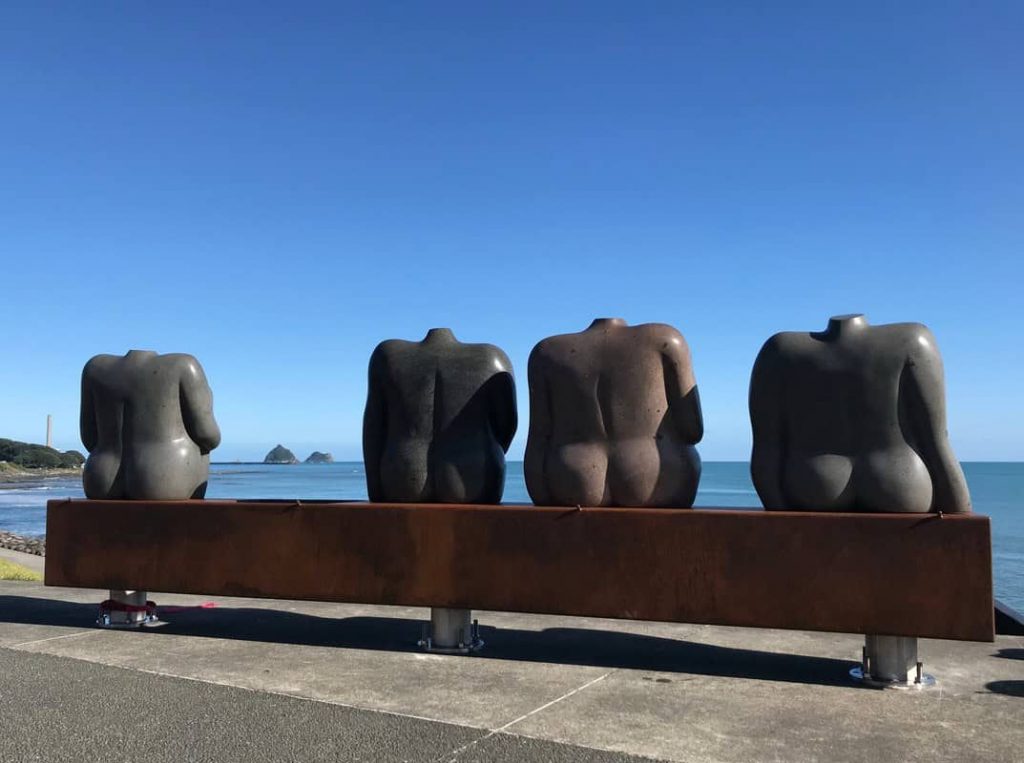
Image Credit: Art In Public Places Trust
In the sprawling landscape of contemporary public art, only a small number of works achieve the rare feat of simultaneously unsettling, enlightening, challenging, and embracing the viewer. Renate Verbrugge’s Mothers and Daughters, a set of four sculpted female figures quietly occupying their place in Christchurch, belongs unequivocally to this select class.
They do not whisper into the environment — they assert, occupy, and echo. Their forms, rounded and unapologetically ample, resist the modern world’s obsession with streamlined silhouettes. Instead, they embody continuity, ancestry, and the deep-rooted corporeality of the maternal line.
And yet, they do something more daring still: they force society to confront itself.
A Quartet of Maternal Archetypes:
The Four Figures That Refuse to Be Ignored
While casual observers may focus instinctively on one dominant figure, the work is not singular. Verbrugge gives us a quartet, a multi-generational echo chamber where bodies are not merely bodies but histories — carried in flesh, posture, and presence.
These four figures allow the viewer to contemplate:
•motherhood as lineage,
•femininity as multiplicity,
•pregnancy as both potential and memory,
•and womanhood as a continuum rather than a moment.
They suggest that maternal identity is never solitary, never confined to one body or one role. Instead, it is shared, inherited, exchanged — a choreography spanning ages, cultures, and truths.
Fat or more likely all pregnant and yet regardless of the constrained plausibility of such a reality within the narrow decades of the 21st century where children can even have two biological mothers. When looking from behind these highly provocative figures and the partially domineeringly lustful position of the mother alone, one can’t help but think of Easter Island — a place that has nothing to do with the great lamb feasts of Christendom, but more for those who are unaware, it’s ancient, somewhat primitive monoliths.
Easter Island, Primitivism, and the Inherited Shape of Memory
The comparison with Easter Island — initially startling — becomes almost inevitable the moment one views Verbrugge’s figures from behind. The stoic solidity, the grounded heaviness, the monumental stance: these are the visual signatures of cultures that worshipped not slimness but endurance, not beauty but continuity.
Like the Moai, the four figures do not seek admiration; they demand contemplation.
Easter Island holds no ties to the feasts of Christendom, yet the juxtaposition illuminates a critical point: Western art history has long attempted to separate the sacred from the “primitive.” Verbrugge collapses this artificial divide, reminding us that what we call primitive is often simply honest, ancestral, or unfiltered.
In this sense, her four figures become bridges linking:
•prehistoric fertility idols,
•medieval Marian iconography,
•early modern domestic portrayals,
•and today’s pluralistic, technology-shifting definitions of motherhood.
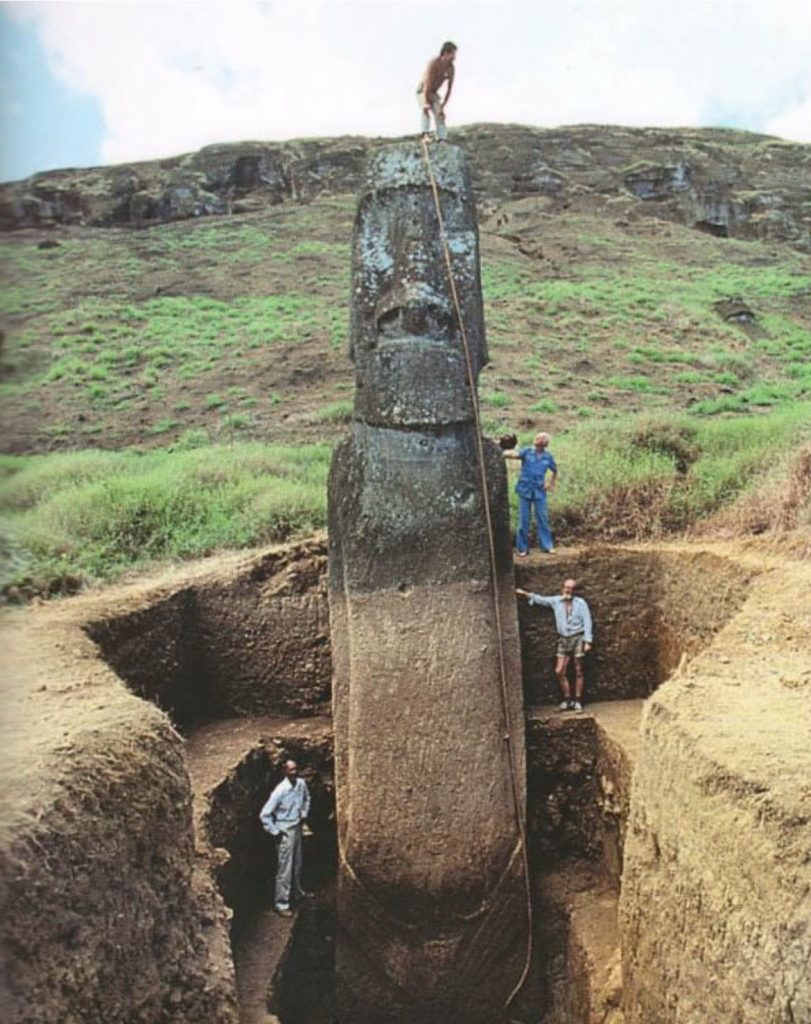
(Easter Island Monolith)
Maternal Bodies in the 21st Century:
Biology, Possibility, and the Expanding Family
We are living in an era where genetic parenthood is undergoing a quiet revolution. To mention that “children can even have two biological mothers” is not speculative fiction but contemporary biomedical fact — an idea that would have confounded even the most advanced civilisations of the past.
Against this backdrop, Verbrugge’s four bodies represent more than symbolic pregnancy:
•They challenge the shrinking visual vocabulary of contemporary femininity.
•They defy the aesthetic marching orders of curated media culture.
•They reclaim space in a world where public sculpture often defaults to photogenic neutrality.
Their roundness becomes a socio-scientific commentary on metabolism, reproduction, technology, and identity.
These are not bodies sculpted for approval; they are bodies sculpted for truth.
Why the Sculpture Divides Opinion — and Why That Is Its Genius
Some describe the figures as “eyesores” — too heavy, too crude, too blunt. But such discomfort exposes a larger cultural bias: contemporary society struggles when femininity is presented in non-commercial, non-sexualised, non-performative forms.
Others see the four figures as profoundly empowering — a celebration of lineage, resilience, and intergenerational truth.
Public art at its highest potency does exactly this:
it compels a city to interrogate the difference between aesthetic preference and cultural meaning.
Verbrugge has created a work that is not decorative but discourse-generating — a rare triumph.
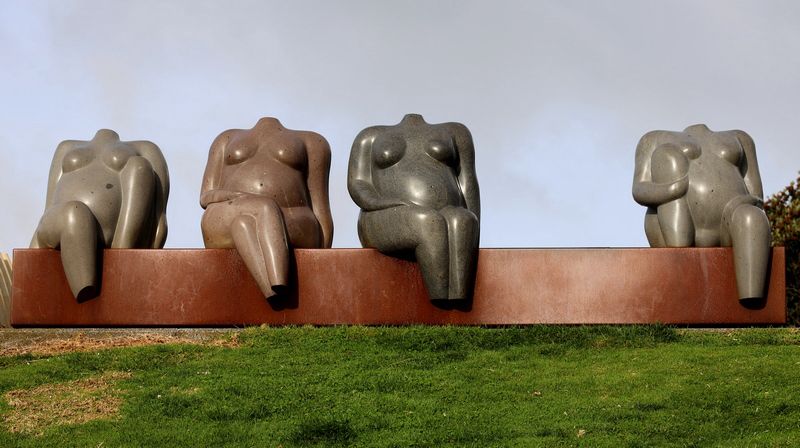
(Renate Verbrugge’s Mothers and Daughters image credit: Sandra’s Garden)
A Public Joy for Mothers and Daughters Alike
The power of the sculpture is not merely intellectual. It is emotional — deeply so. Mothers recognise themselves in its forms. Daughters glimpse the unspoken strength of those who came before. Grandmothers see life’s full arc reflected in stone.
The four figures become:
•a mirror,
•a warning,
•a celebration,
•a continuity,
•a unified story told in four silhouettes.
There is no eyesore here.
No regression to the Stone Age.
No artistic clumsiness.
What stands before us is a masterstroke of human truth, carved not to please but to reveal.
Conclusion:
These Are Not Primitive Forms — They Are Human Truths in Monumental Form
In a century that increasingly elevates digital perfection and curated identity, Mothers and Daughters stands as a counter-force — an anchor pulling us back toward realism, ancestry, and the visceral corporeal truth of life itself.
Verbrugge’s four figures are not crude.
They are not simplistic.
They are not relics.
They are the living genealogy of womanhood, rendered in stone so that no era — not even ours — can forget the bodies that shape the world.